Source
Adapted from my own handwritten and hand-typed notes from Year 1 to Year 3 of my EEE degree
Why Expand
Memory chips come in fixed sizes, so a larger memory is built from several chips. There are two directions, and they can be combined.
Word-Length Expansion
Increase the data width without adding address lines.
Method:
- all chips share the same address, chip select and control lines
- each chip supplies its own slice of the data bus
Examples:
- four 64k x 1 RAMs form a 64k x 4 RAM
- four 64k x 8 RAMs form a 64k x 32 RAM
Word-Capacity Expansion
Increase the number of words, which needs more address lines.
Method:
- the low address bits go to every chip in parallel
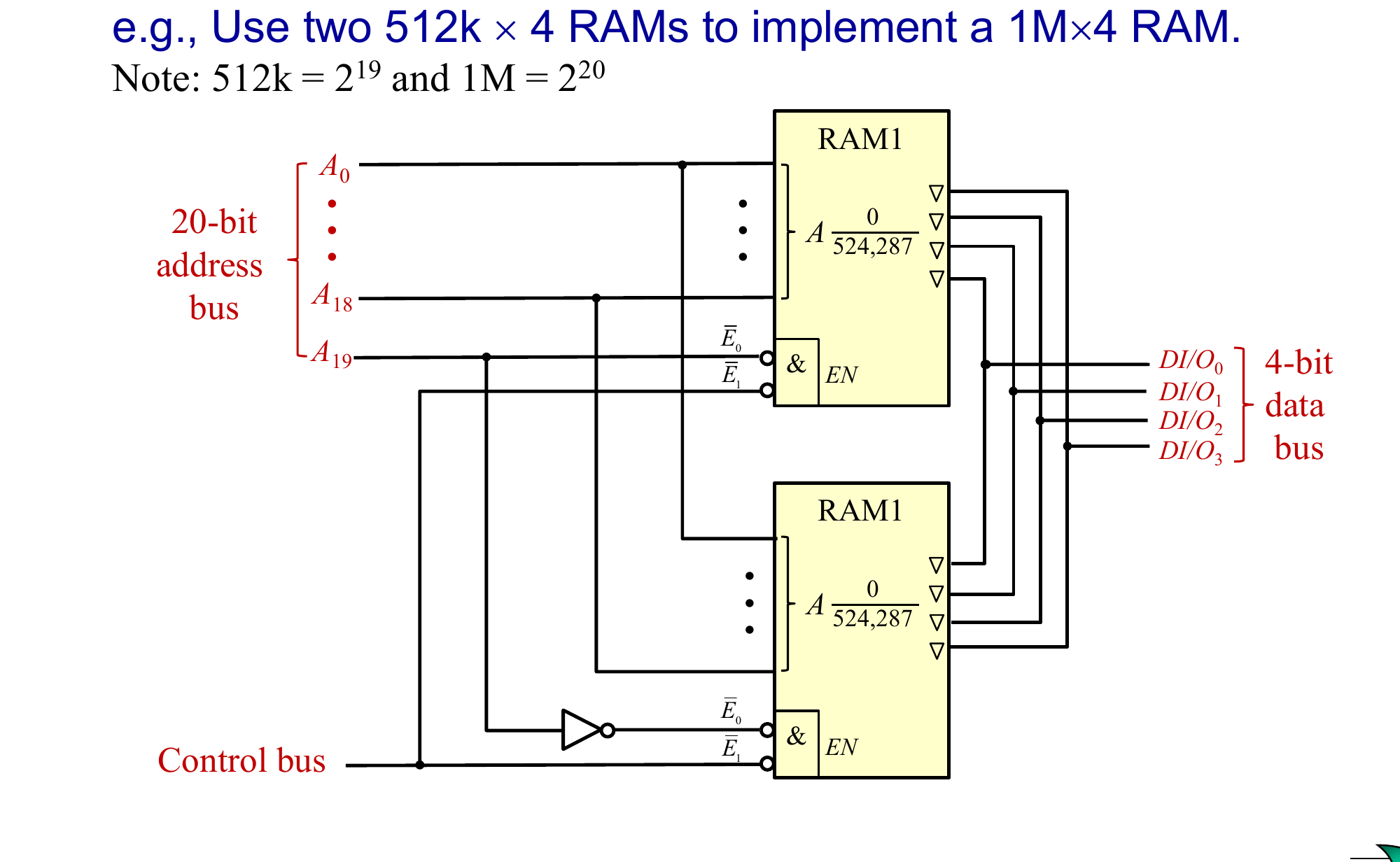
- the extra high address bits are decoded to drive the chip enables, so exactly one chip is active for each address
- all chips share the same data bus, which works because inactive chips put their outputs in the high-impedance state
Example: two 512k x 4 RAMs form a 1M x 4 RAM. Since and , address lines A0 to A18 go to both chips and A19 selects one: A19 = 0 enables RAM 1 (addresses 0 to 524,287) and A19 = 1 enables RAM 2 through an inverter.
Number of Chips
To build a memory from chips:
with extra address bits going to a decoder for the chip enables. The address and data organisation inside each chip follows Memory Arrays and ROM.