Source
Adapted from my own handwritten and hand-typed notes from Year 1 to Year 3 of my EEE degree
Definition
A shift register is a chain of flip-flops that stores data and moves it one bit position left or right on each clock pulse. Each flip-flop stores one bit, so the storage capacity equals the number of flip-flops. Unlike a counter, a shift register has no fixed sequence of states.
A D flip-flop is the storage element: on each triggering edge becomes , or keeps its value if already matches.
Data Movement
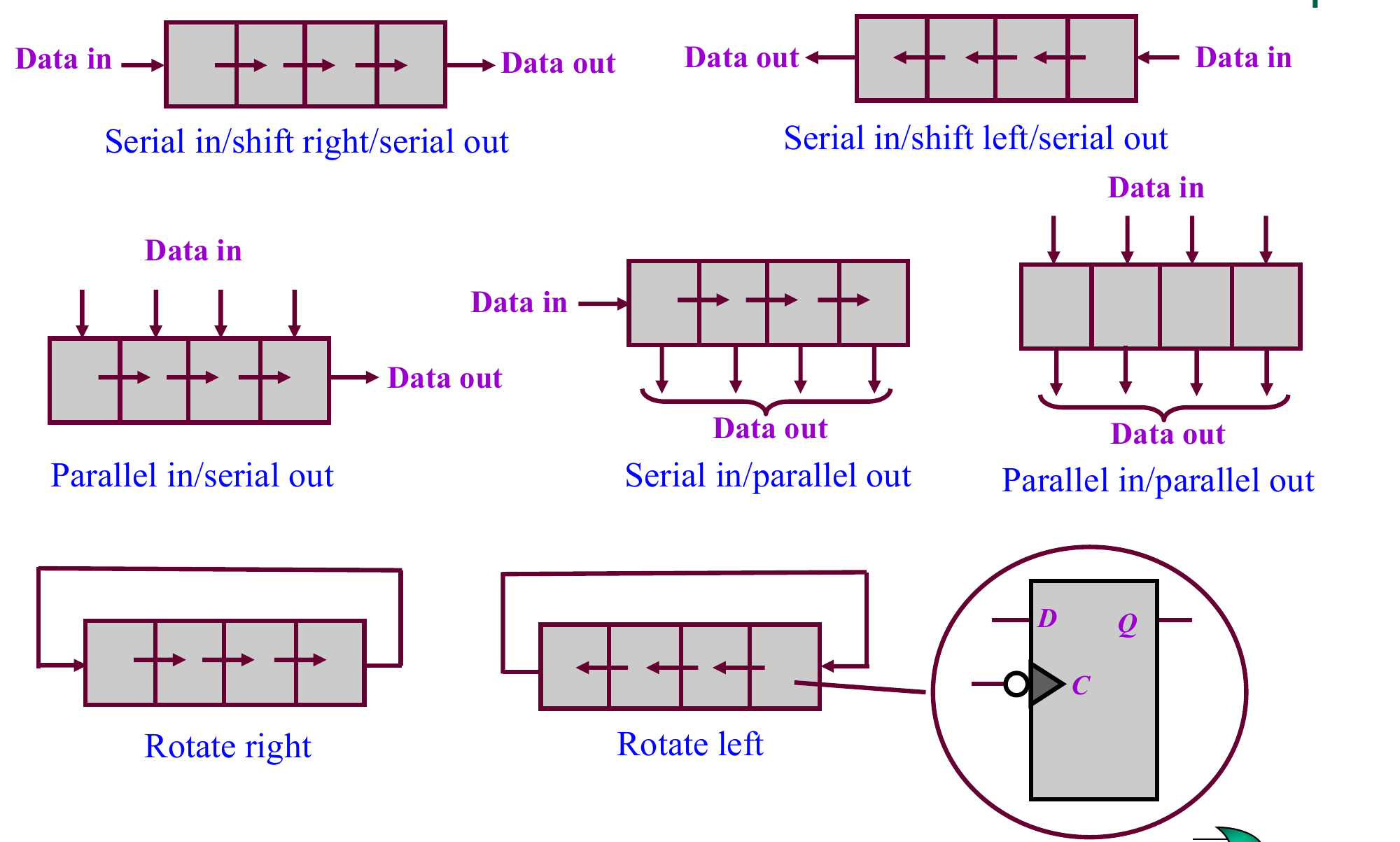
Modes:
- serial in, serial out (shift right or shift left)
- serial in, parallel out
- parallel in, serial out
- parallel in, parallel out
- rotate right or rotate left (output fed back to input)
A universal shift register supports serial and parallel input and output, with preset (load), shift clock and clear controls.
Serial In, Serial Out
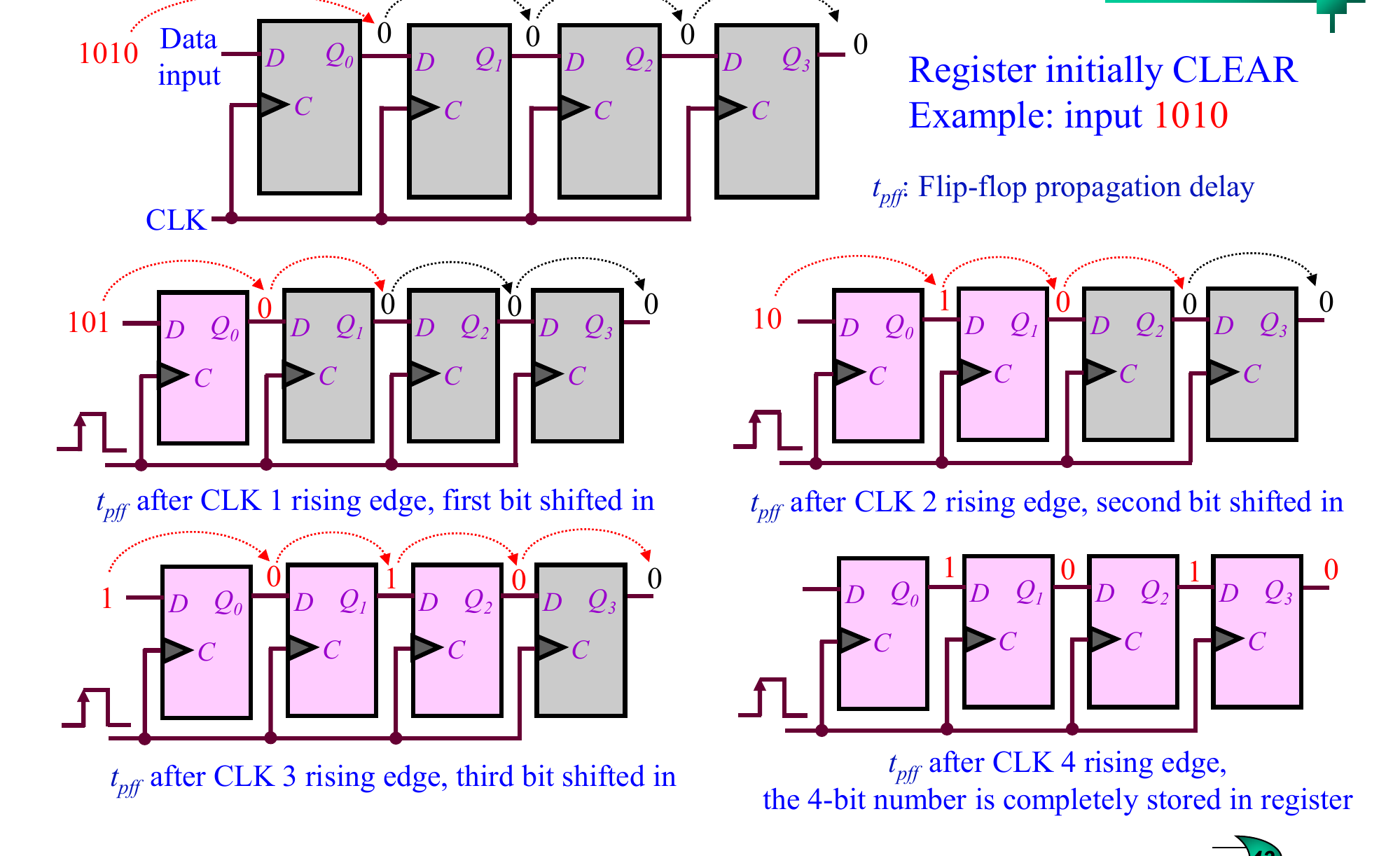
Data enters the first flip-flop and moves one stage per clock. Loading 1010 into a cleared 4-bit register takes 4 clock pulses, one bit after each rising edge. Reading it back out serially takes another 4 pulses.
Parallel Load
For parallel in, serial out, each stage has a 2-to-1 MUX in front of its D input:
- LOAD/ = 1: each flip-flop takes its parallel input
- LOAD/ = 0: each flip-flop takes the output of the previous stage, and SERIN feeds the first stage
A serial in, parallel out register simply makes every available as an output.
Standard ICs
| Device | Features |
|---|---|
| 7491A | 8-bit, serial in, serial out |
| 7496 | 5-bit, serial in/out, async preset, parallel out, common clear |
| 74164 | 8-bit, serial in, serial or parallel out, common clear |
| 74165 | 8-bit, serial in/out, async load, clock inhibit |
| 74179 | 4-bit, serial in/out, sync load, parallel out, sync hold |
| 74194 | 4-bit bidirectional, serial in/out, sync load, parallel out, clock inhibit |
In the 74164 the serial input is (two gated inputs) and doubles as the serial output.
Clock Skew
If the clock reaches the destination flip-flop later than the source by more than the source's , the destination captures the new value instead of the old one and a bit is lost. Clock skew must stay below the flip-flop delay.
Applications
Uses:
- parallel to serial conversion for serial links, e.g. inside a UART between a microprocessor bus and a serial device
- time delay of a bit stream by n clock periods
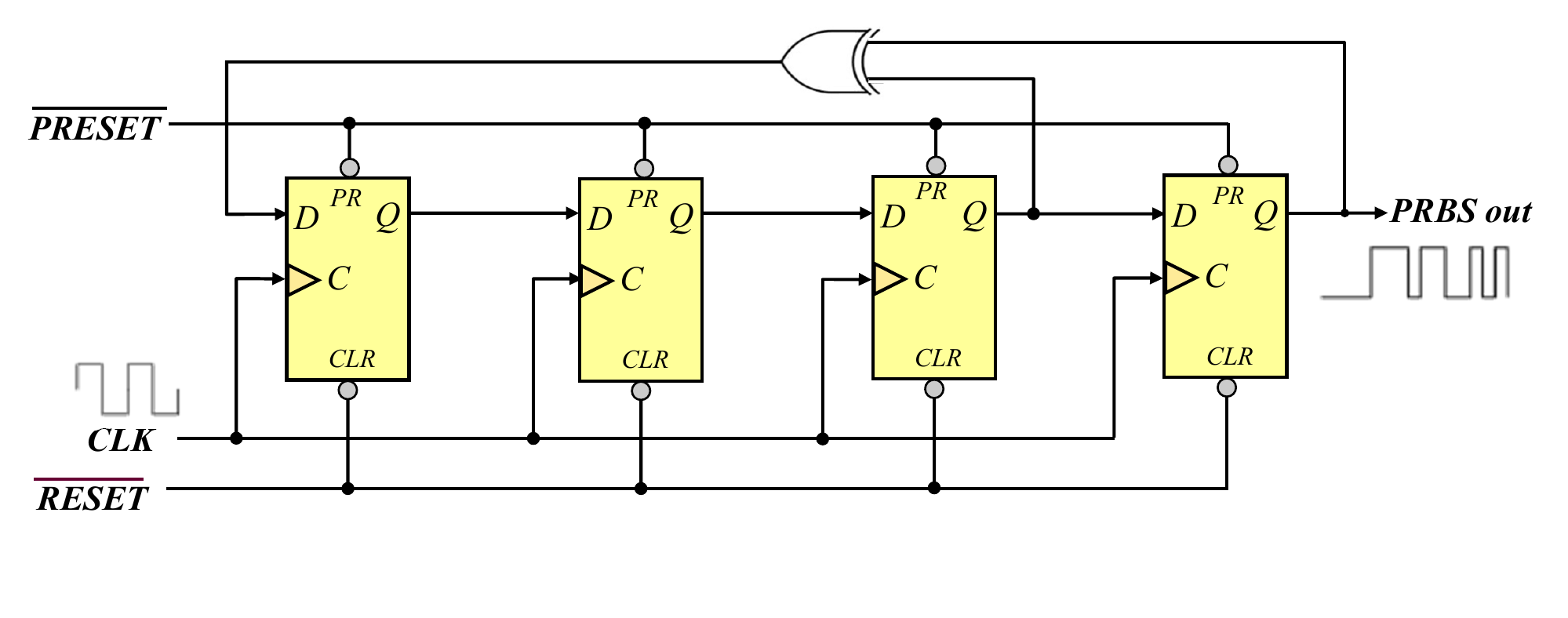
- pseudo-random pattern generator: the vacant bit is filled with the XOR of the last two bits, an n-bit register gives up to patterns, used for test pattern generation
- shift register counters, see Ring and Johnson Counters