Source
Adapted from my own handwritten and hand-typed notes from Year 1 to Year 3 of my EEE degree
Shift Register Counters
A shift register with feedback from the last stage to the first produces a fixed repeating pattern. These are ring and twisted ring counters.
Ring Counter
The output of the last flip-flop feeds the serial input. One flip-flop is preset to 1 and the rest cleared, so a single 1 circulates around the ring.
Properties:
- an n-bit ring counter has only n states
- the outputs are already decoded (one-hot), so no decoder is needed and there are no decoding glitches
- it uses more flip-flops than a binary counter with the same number of states
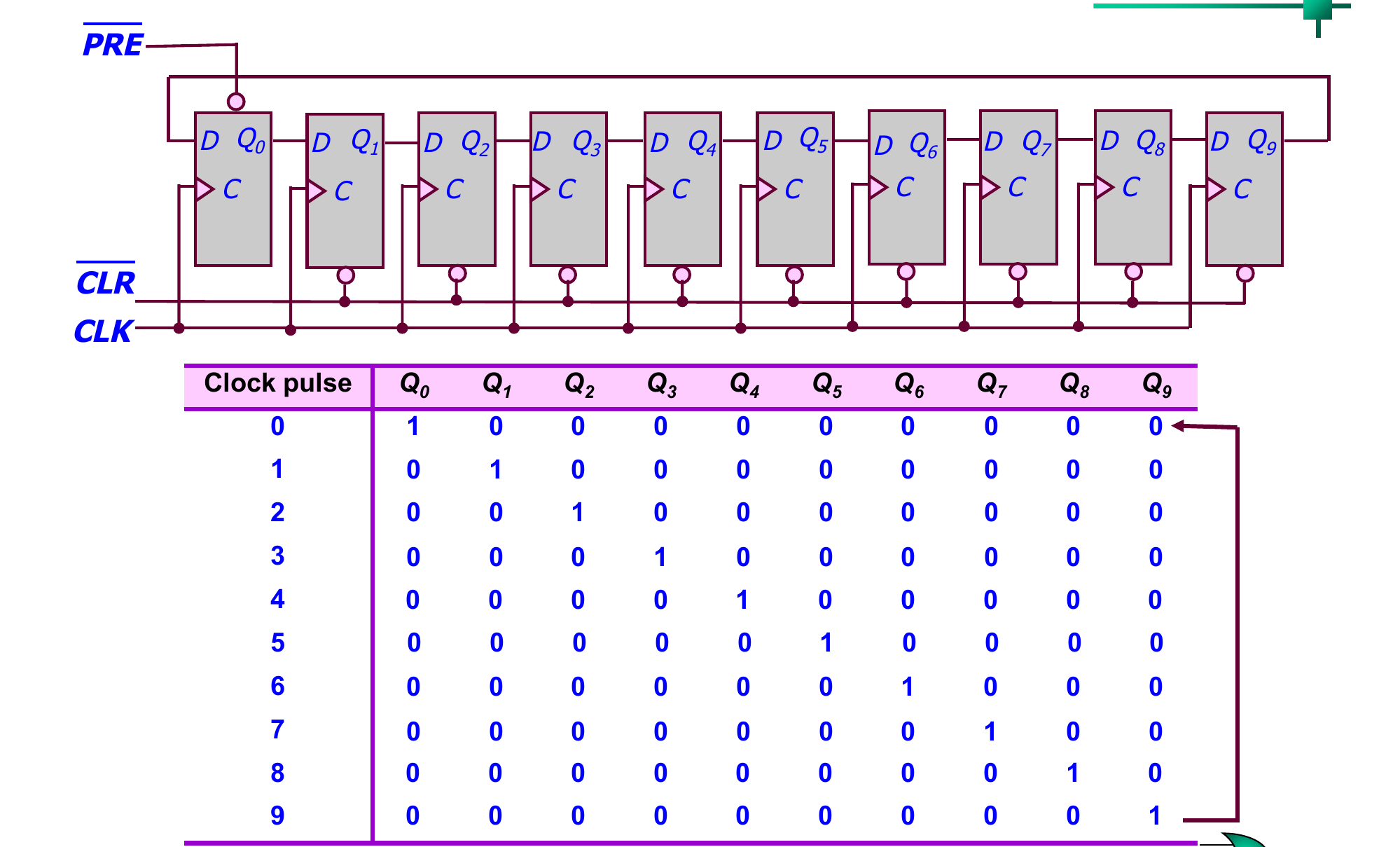
The same one-hot outputs can be made from a k-bit binary counter driving a k-to- decoder, which uses fewer flip-flops but may glitch at the decoder outputs.
Johnson (Twisted Ring) Counter
The complement of the last flip-flop feeds the first stage. Also called a Johnson or Moebius counter.
Properties:
- an n-bit Johnson counter cycles through 2n states
- starting from all 0s it fills with 1s from the left, then fills with 0s
- each state can be decoded with a single 2-input AND gate
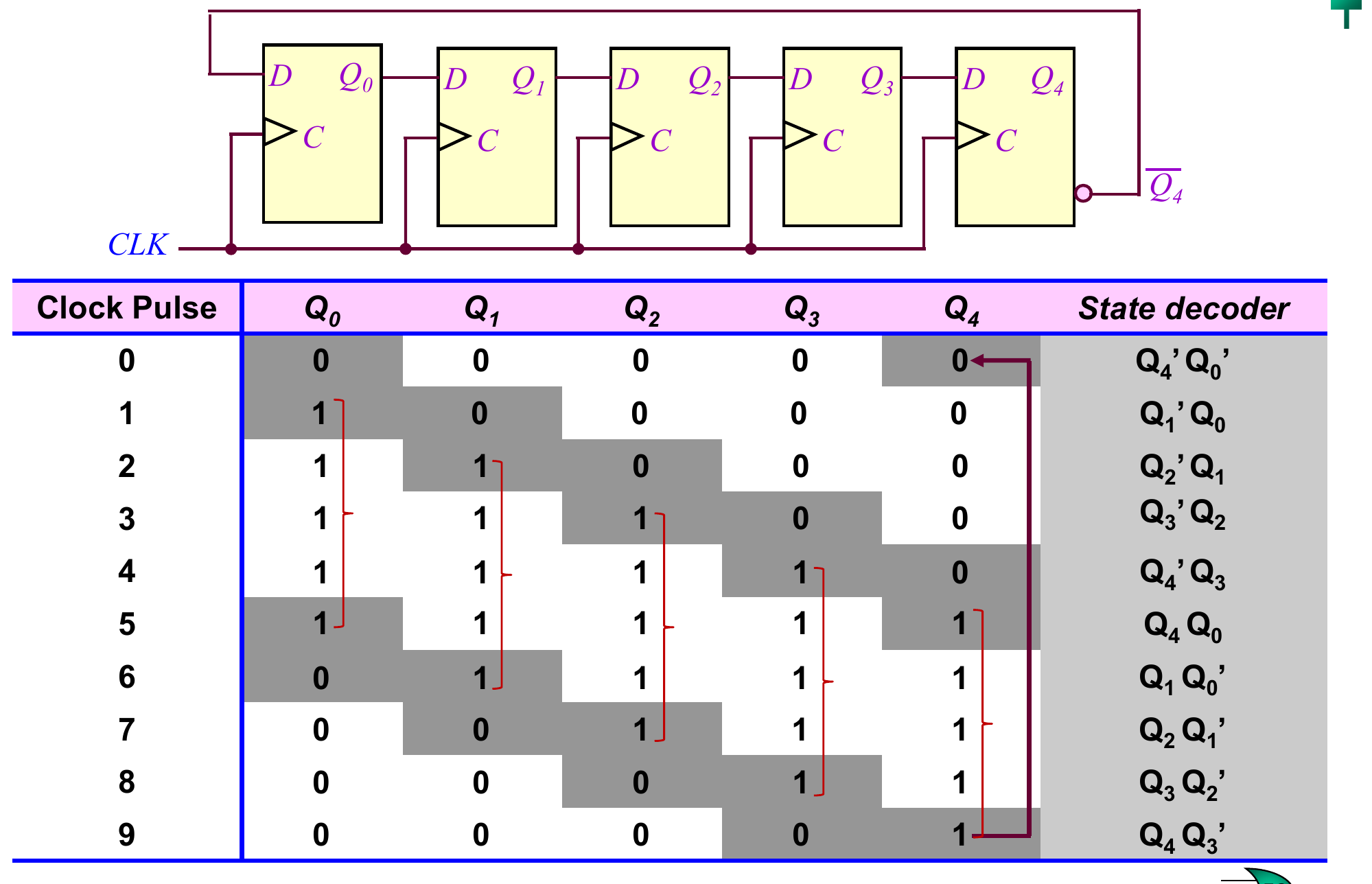
5-bit sequence and decoding:
| Clock | Decode | |
|---|---|---|
| 0 | 00000 | |
| 1 | 10000 | |
| 2 | 11000 | |
| 3 | 11100 | |
| 4 | 11110 | |
| 5 | 11111 | |
| 6 | 01111 | |
| 7 | 00111 | |
| 8 | 00011 | |
| 9 | 00001 |
An n-bit Johnson counter uses unused codes. Without a correction circuit it can get trapped in an unused loop after power on, so it should start from a reset.