Source
Adapted from my own handwritten and hand-typed notes from Year 1 to Year 3 of my EEE degree
Ripple Counters
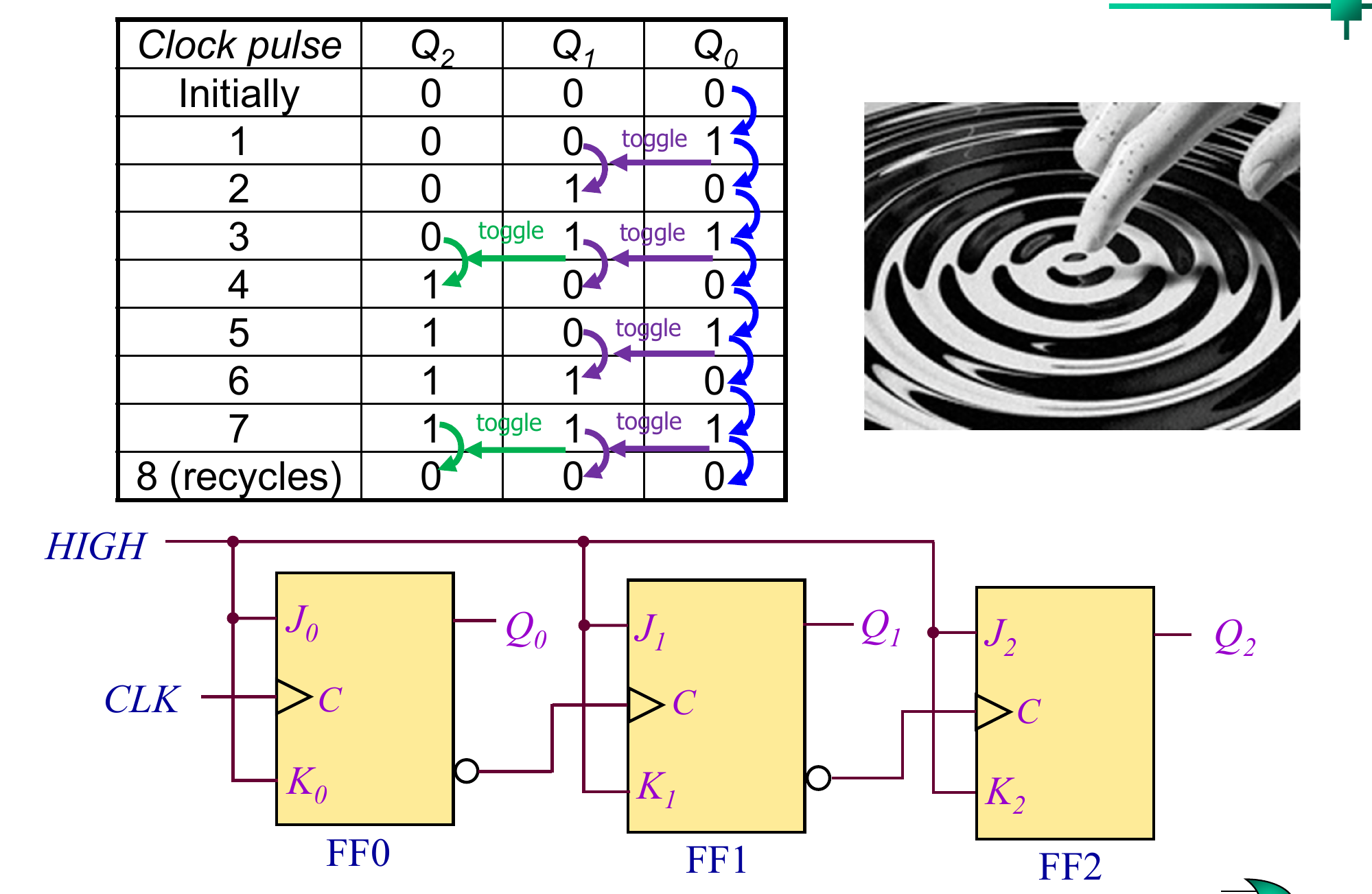
In an asynchronous (ripple) counter only the first flip-flop gets the external clock. Each later flip-flop is clocked by the output of the one before it, so the flip-flops do not change at the same time.
Pros and cons:
- fewer gates than a synchronous counter, since no AND chain is needed
- each stage adds a flip-flop delay, so the final output settles only after the delay ripples through the whole chain
3-Bit Asynchronous Binary Counter
All JK flip-flops have (toggle). With falling-edge flip-flops, clocks FF1 and clocks FF2: each stage toggles when the stage below goes from 1 to 0, which is exactly binary counting. It counts 0 to 7 and recycles to 0 after the 8th clock.
Propagation Delay
changes or after the clock edge, changes one flip-flop delay after , and so on. For n stages the worst-case settling time is about .
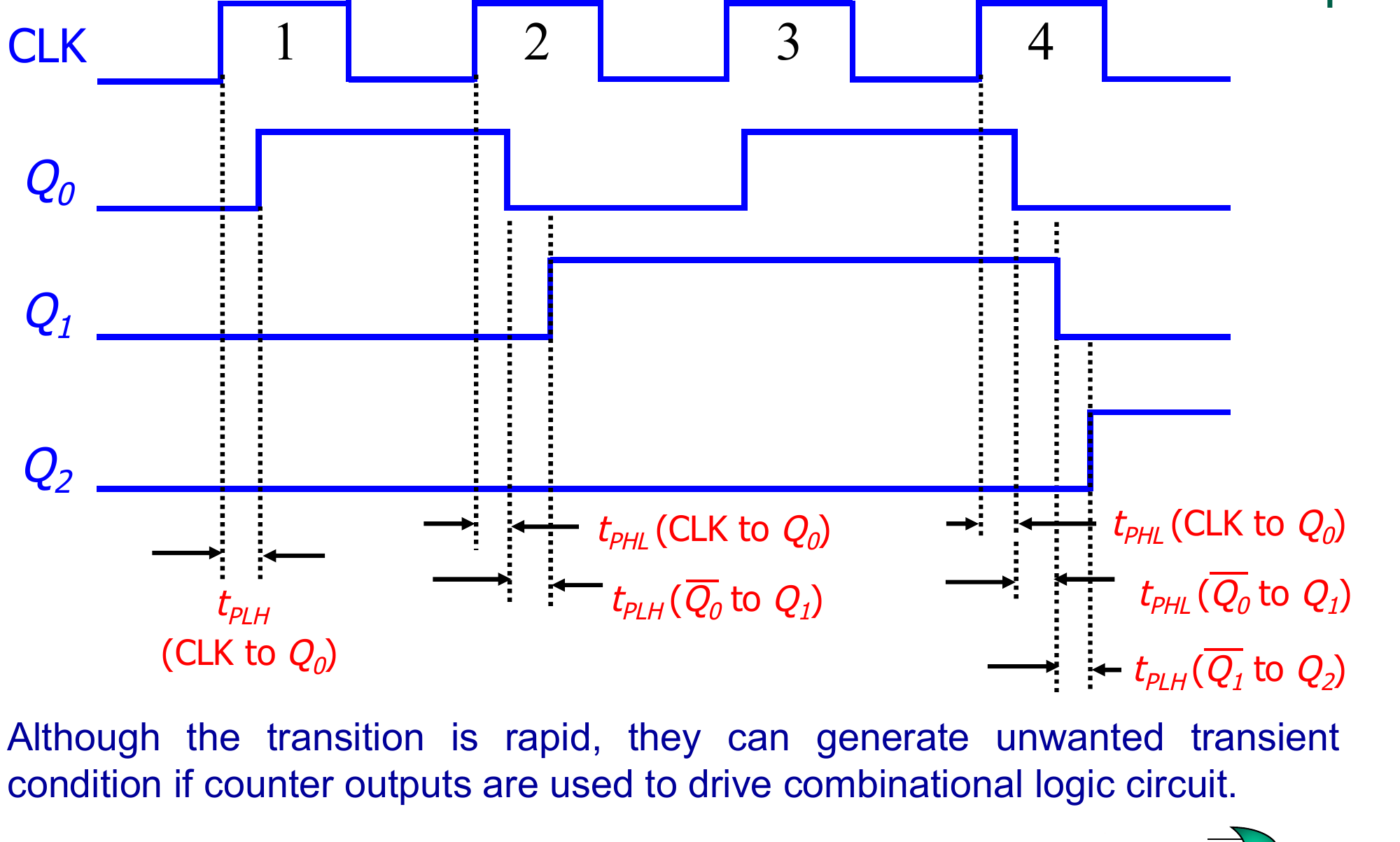
The transitions are quick, but during the ripple the outputs pass through wrong intermediate states. If the outputs drive combinational logic (e.g. a decoder), these short transients can cause glitches.
Asynchronous BCD Decade Counter
A 4-bit ripple counter is made to recycle at 10 by detecting 1010 with a NAND gate ( and ) and feeding it to all the inputs. This is asynchronous recycling.
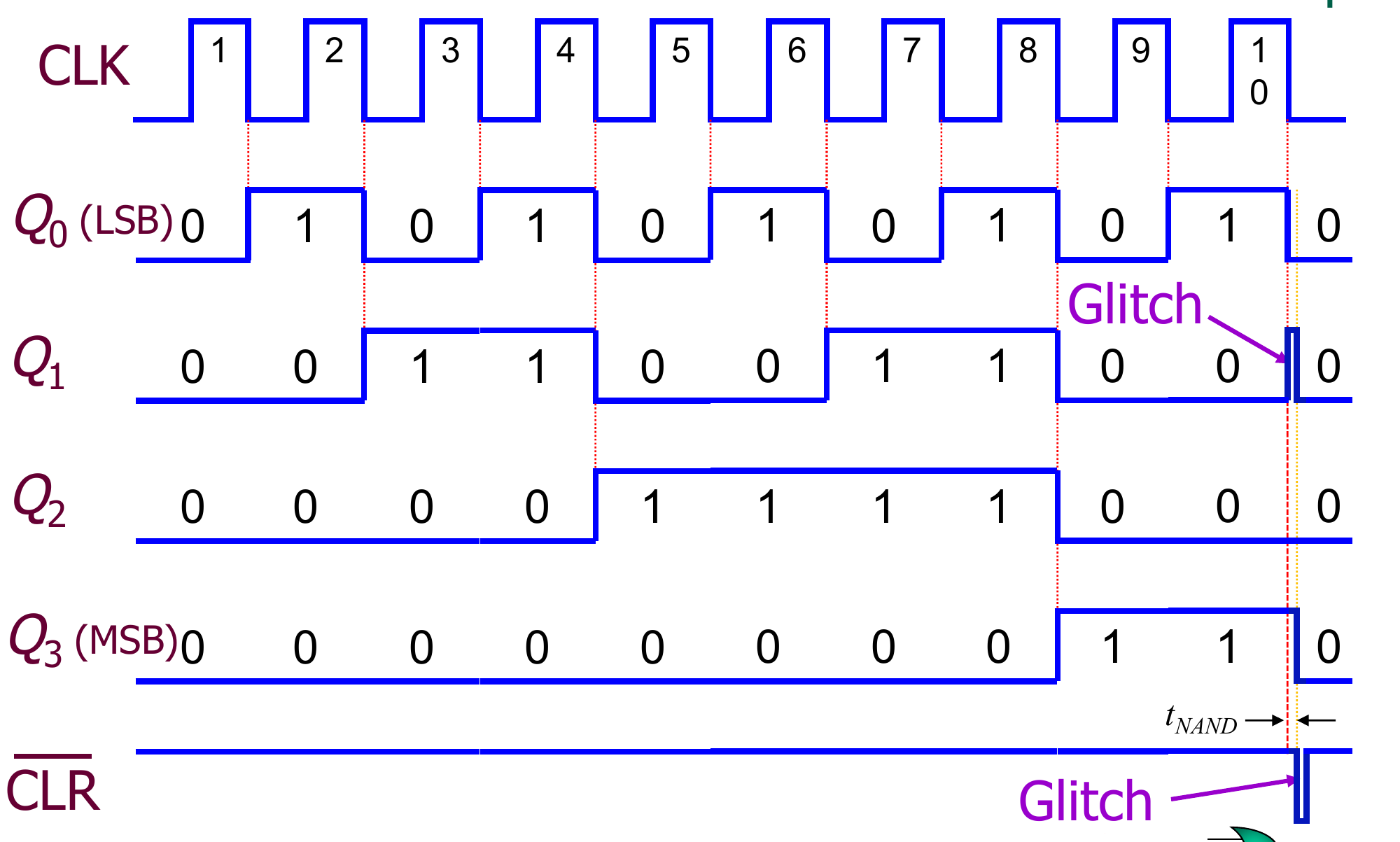
Weakness: the counter really does enter state 1010 for a moment (about plus the clear delay) before being cleared. This creates a short glitch on and on , which may upset any logic that reads the outputs.