Source
Adapted from my own handwritten and hand-typed notes from Year 1 to Year 3 of my EEE degree
Symbols
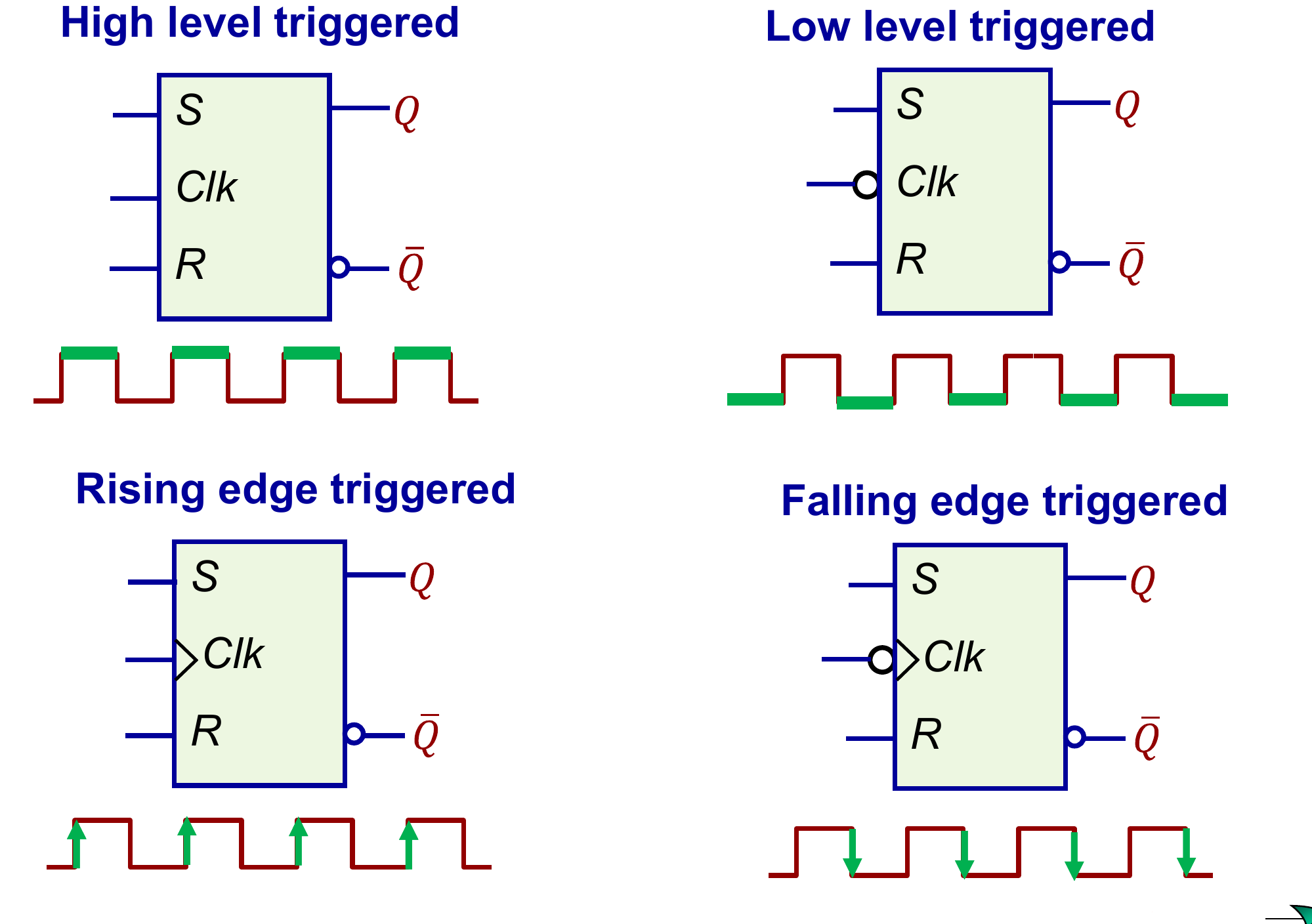
Symbol conventions:
- plain input: high-level triggered
- bubble on : low-level triggered
- triangle (dynamic indicator) on : rising-edge triggered
- bubble and triangle: falling-edge triggered
Three Triggering Schemes
| Scheme | Implementation | Behaviour |
|---|---|---|
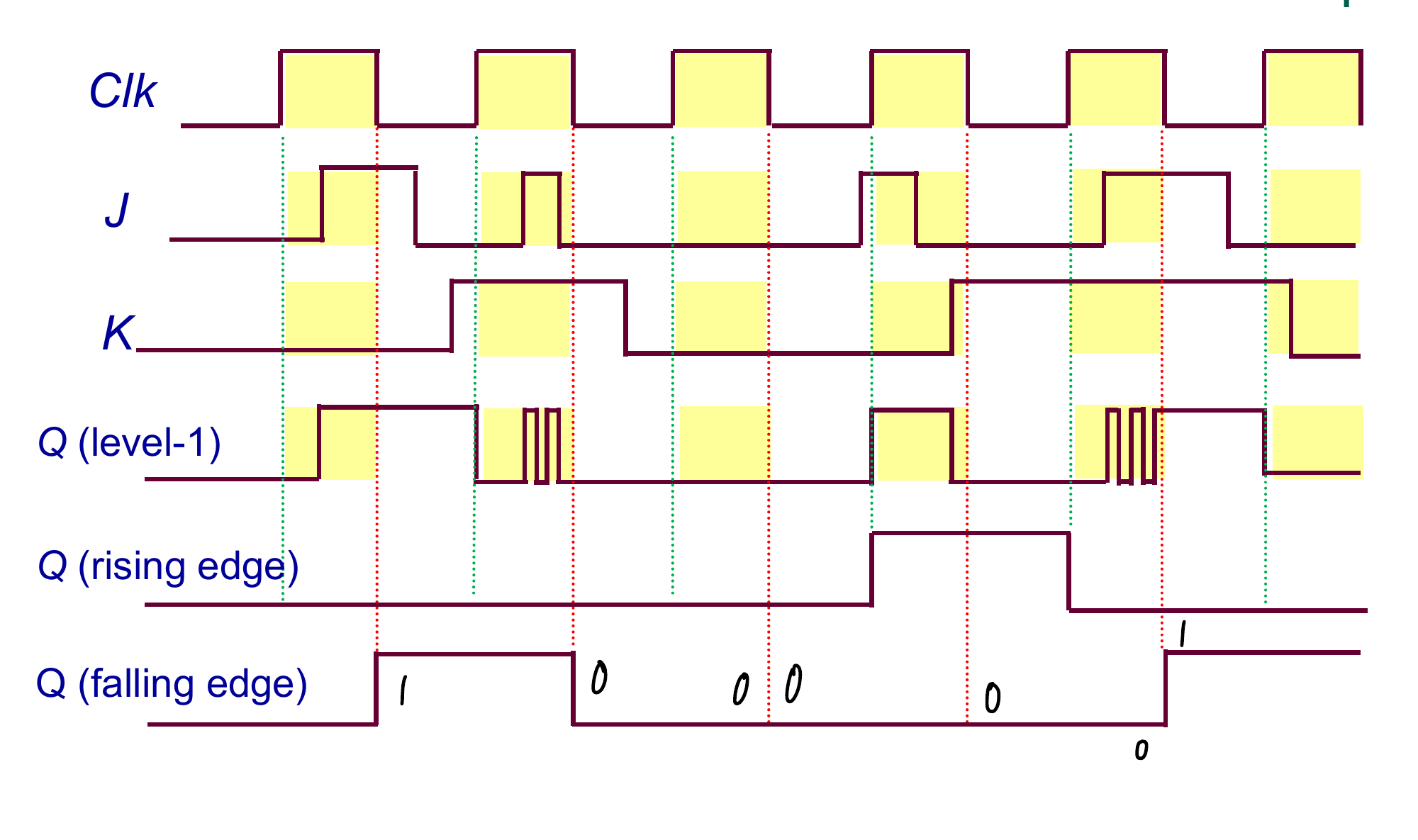
| Level triggering | clock simply gates the inputs | output can change at any time while the clock is active, may be unstable (JK toggles repeatedly) |
| Pulse triggering | master-slave pair | output changes at a clock edge, but suffers from ones catching and zeros catching |
| Edge triggering | pulse transition detector | output changes only at the clock edge, the main scheme used today |
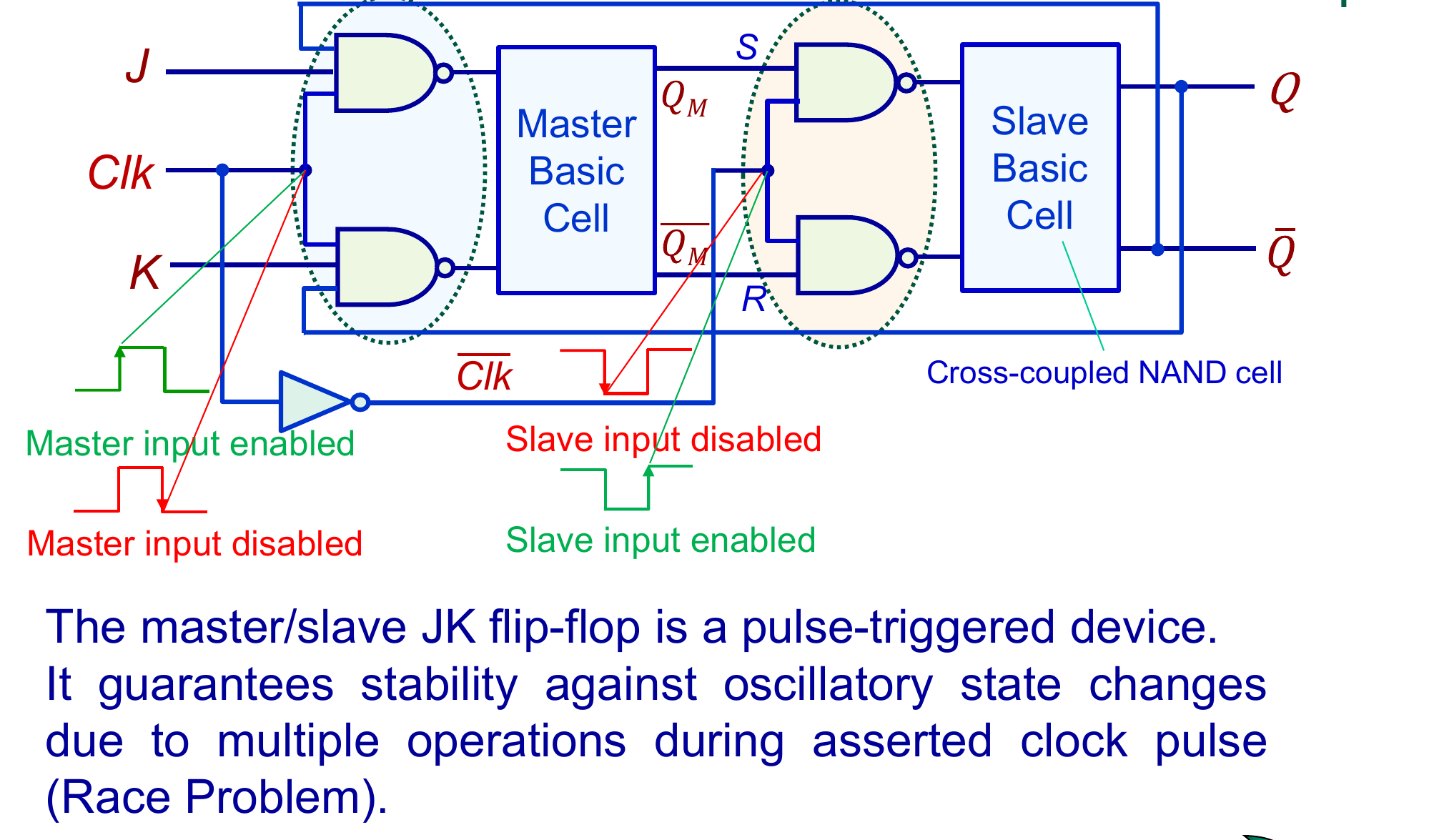
Master-Slave JK Flip-Flop
Two basic cells in series, the slave driven by the inverted clock:
- while is high, the master cell is loaded from , and the fed back outputs, and the slave is disabled
- when falls, the master is disabled and the slave copies the master, updating and
- the new outputs only reach the master inputs after it is disabled, so there is no toggle race
So this circuit is pulse triggered and its output changes on the falling edge. Its weakness is that the master can "catch" a short glitch on or while the clock is high (ones and zeros catching).
Edge Triggering With a Pulse Transition Detector
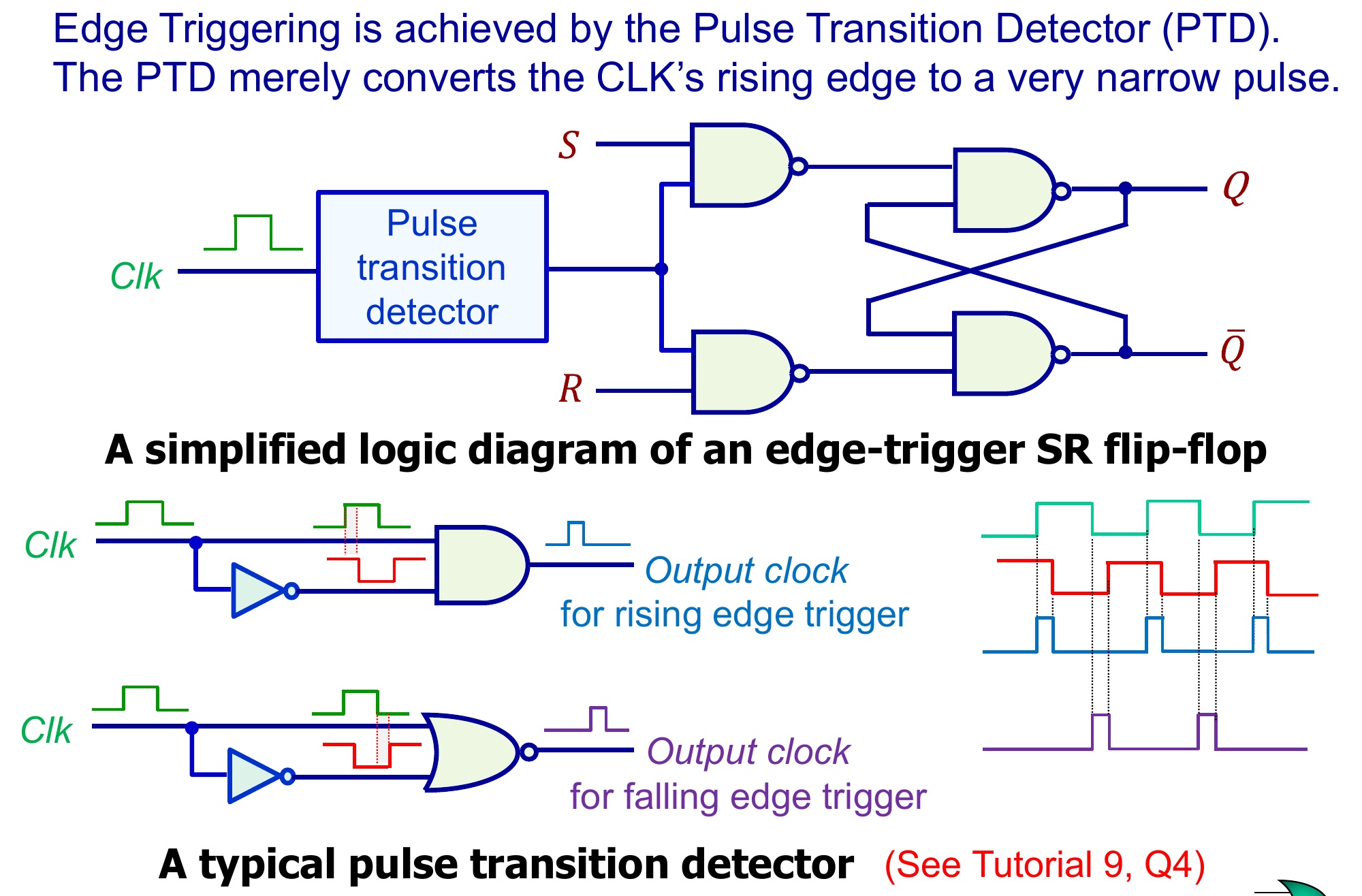
A pulse transition detector (PTD) turns a clock edge into a very narrow pulse, so the flip-flop inputs are enabled only for an instant.
How it works:
- the clock and a delayed, inverted copy of the clock go into an AND gate
- for a short time after the rising edge both are 1, giving a narrow pulse equal to the inverter delay
- using a NOR gate instead gives a pulse on the falling edge
Asynchronous Preset and Clear
Most IC flip-flops have preset () and clear () inputs, usually active low:
- they completely override , (or ) and the clock
- they are not synchronised to the clock and act immediately
- they are used to force a known starting state, e.g. at power on or reset
Edge-triggered flip-flops still need their inputs to be stable around the edge, which is the topic of Setup and Hold Time.