Source
Adapted from my own handwritten and hand-typed notes from Year 1 to Year 3 of my EEE degree
Unbalanced Three-Phase Systems
A system is unbalanced if the source voltages are unequal in size or not apart, or if the load impedances are unequal. Usually the source is assumed balanced and only the load is unbalanced.
How to solve:
- there is no per-phase shortcut, so use KCL, KVL, mesh or nodal analysis directly
- four-wire Y load: , , , and the neutral carries
- three-wire system: , and the line currents are found by mesh analysis
- total power is the sum of the three phase powers, not three times one phase
Two-Wattmeter Method
The two-wattmeter method is the most common way to measure three-phase power, and it works for balanced or unbalanced, Y or loads in a three-wire system.
Two-Wattmeter Connection
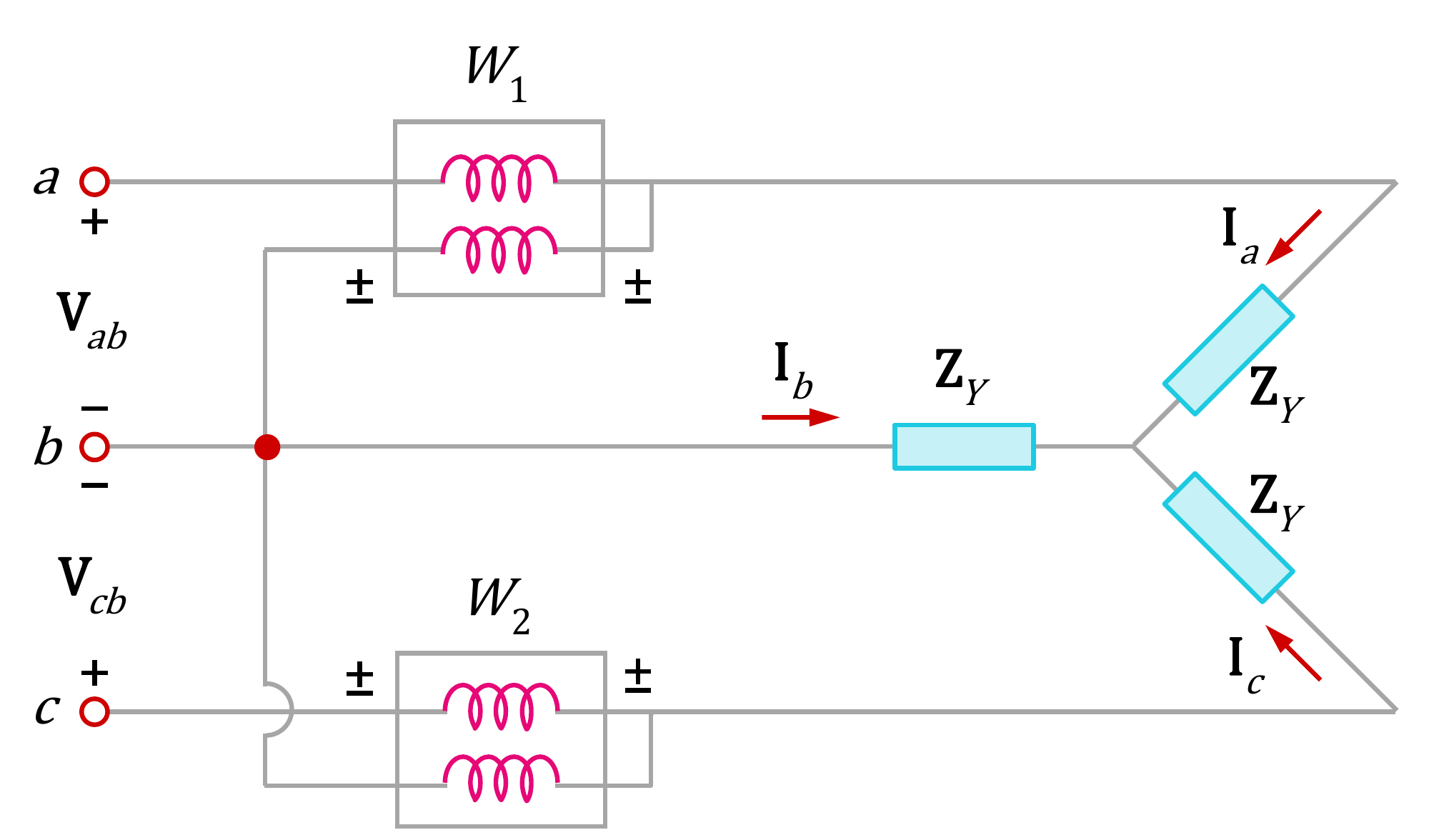
Connection:
- the current coils of and are in lines a and c
- each voltage coil is connected from its own line to the third line b
- total real power is the algebraic sum
Balanced Load Readings
For a balanced load with impedance angle (abc sequence), the angle between and is , so
Reading the load type:
- : resistive load
- : inductive load
- : capacitive load
- if , becomes negative
Worked Example
A balanced Y load on 208 V lines:
- A
- W
- W
- W and VAR, inductive since
These agree with the formulas in Power in Balanced Three-Phase Systems.