Source
Adapted from my own handwritten and hand-typed notes from Year 1 to Year 3 of my EEE degree
Constant Instantaneous Power
For a balanced Y load with (and the other phases shifted by ) and , the phase currents are and so on. Adding the three instantaneous powers, all the terms cancel:
The total instantaneous power is constant in time, whether the load is Y or . This is the key advantage of three-phase supply.
Power Formulas
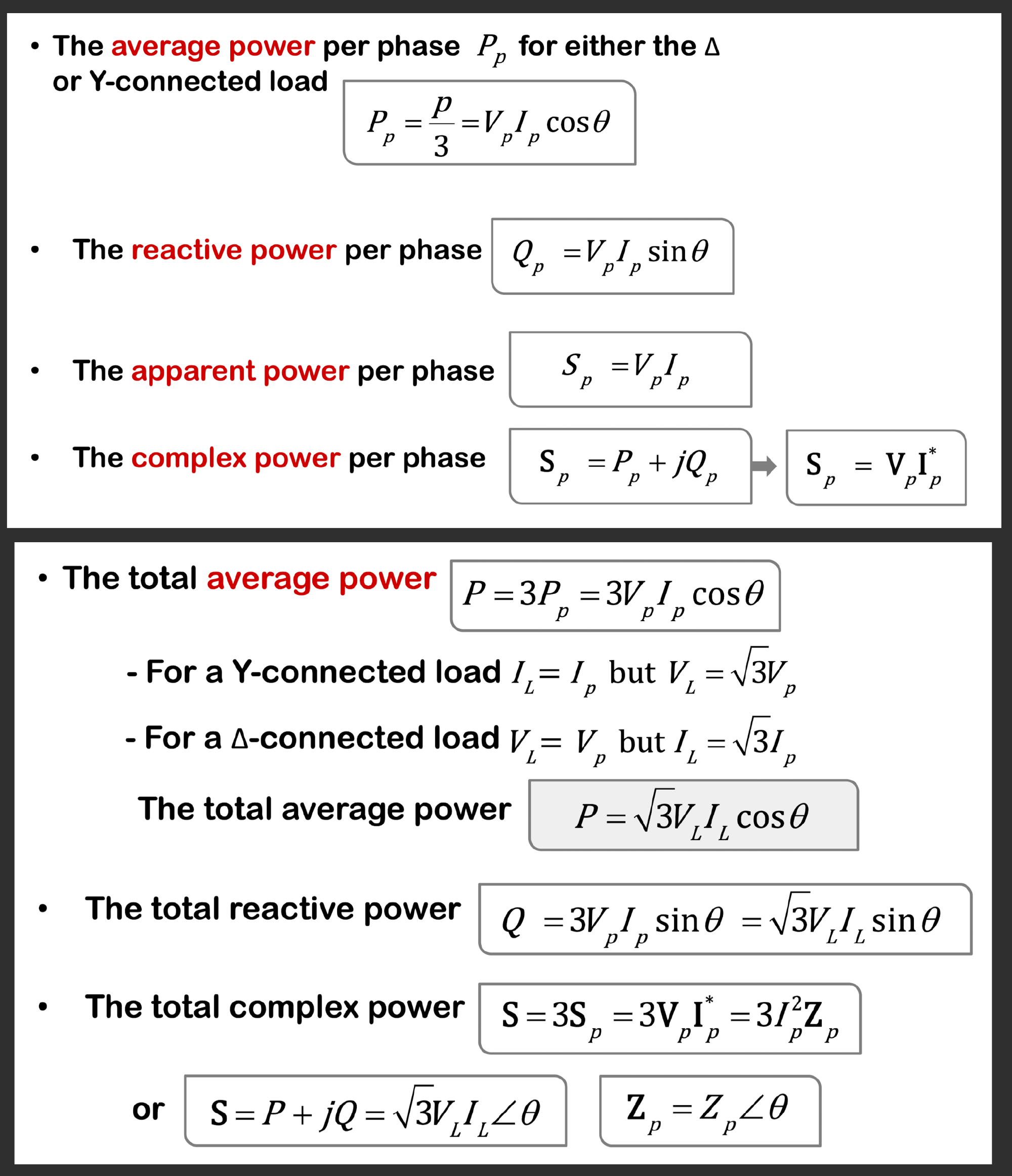
Per phase ( and are rms phase values, is the load impedance angle):
- average power
- reactive power
- apparent power
- complex power
Total, using either phase or line values:
The line form works for both Y (, ) and (, ). Note that is always the angle of the phase impedance, not the angle between line voltage and line current.
Worked Example
A three-phase motor (balanced Y load) draws 5.6 kW at a line voltage of 220 V and line current of 18.2 A:
(lagging because a motor is inductive). How this power is measured is in Three-Phase Power Measurement.