Source
Adapted from my own handwritten and hand-typed notes from Year 1 to Year 3 of my EEE degree
A three-phase system uses three sources with the same amplitude and frequency but apart in phase. Nearly all electric power is generated and distributed this way, and single-phase supplies are taken from it.
Advantages:
- the total instantaneous power of a balanced three-phase system is constant, giving smooth transmission and less vibration in machines
- less conductor material is needed for the same power than with single-phase
Three-Phase Generator
A rotating magnet (rotor) sits inside a stationary winding (stator) with three coils a-a', b-b', c-c' placed apart. As the rotor turns, it induces three voltages that are equal in size and apart in time.
Source Connections
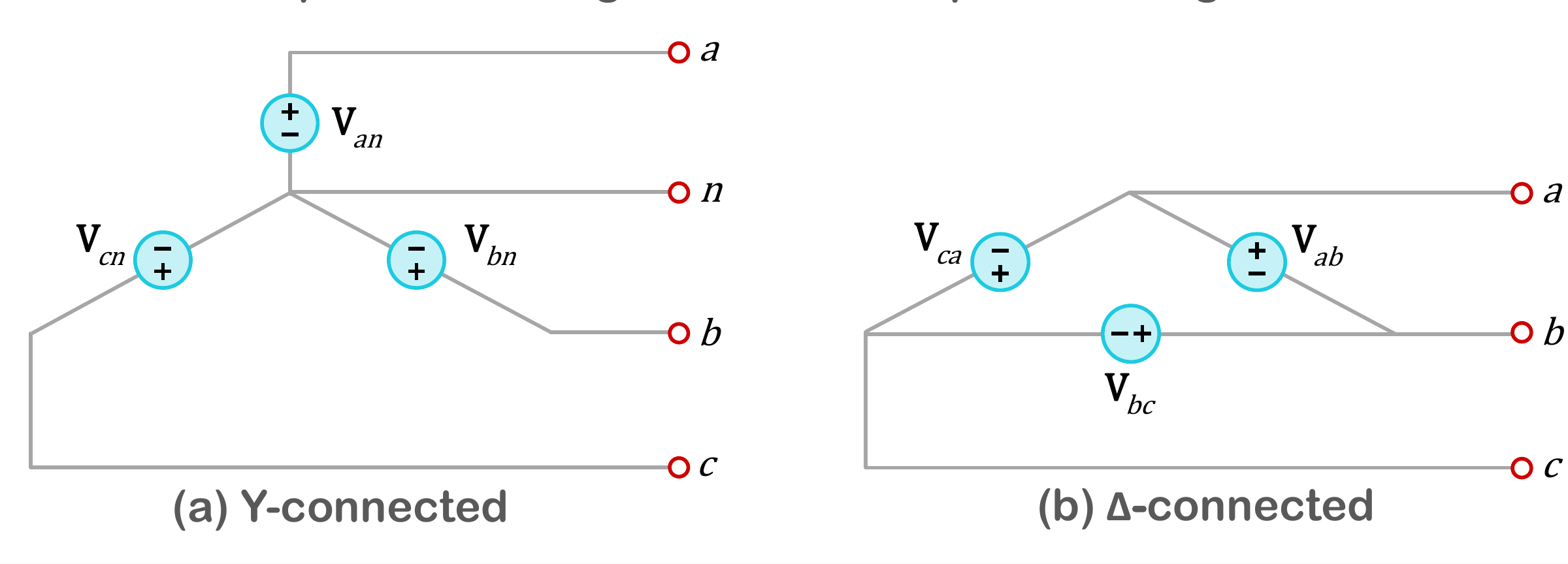
Two ways to connect the sources:
- Y-connected: each source sits between a line (a, b, c) and the neutral n, giving phase voltages
- -connected: sources sit between pairs of lines, giving directly, with no neutral
Balanced Phase Voltages and Sequence
Balanced phase voltages are equal in magnitude and apart, so
The phase sequence is the order in which the voltages reach their peaks.
Positive Sequence Phasors
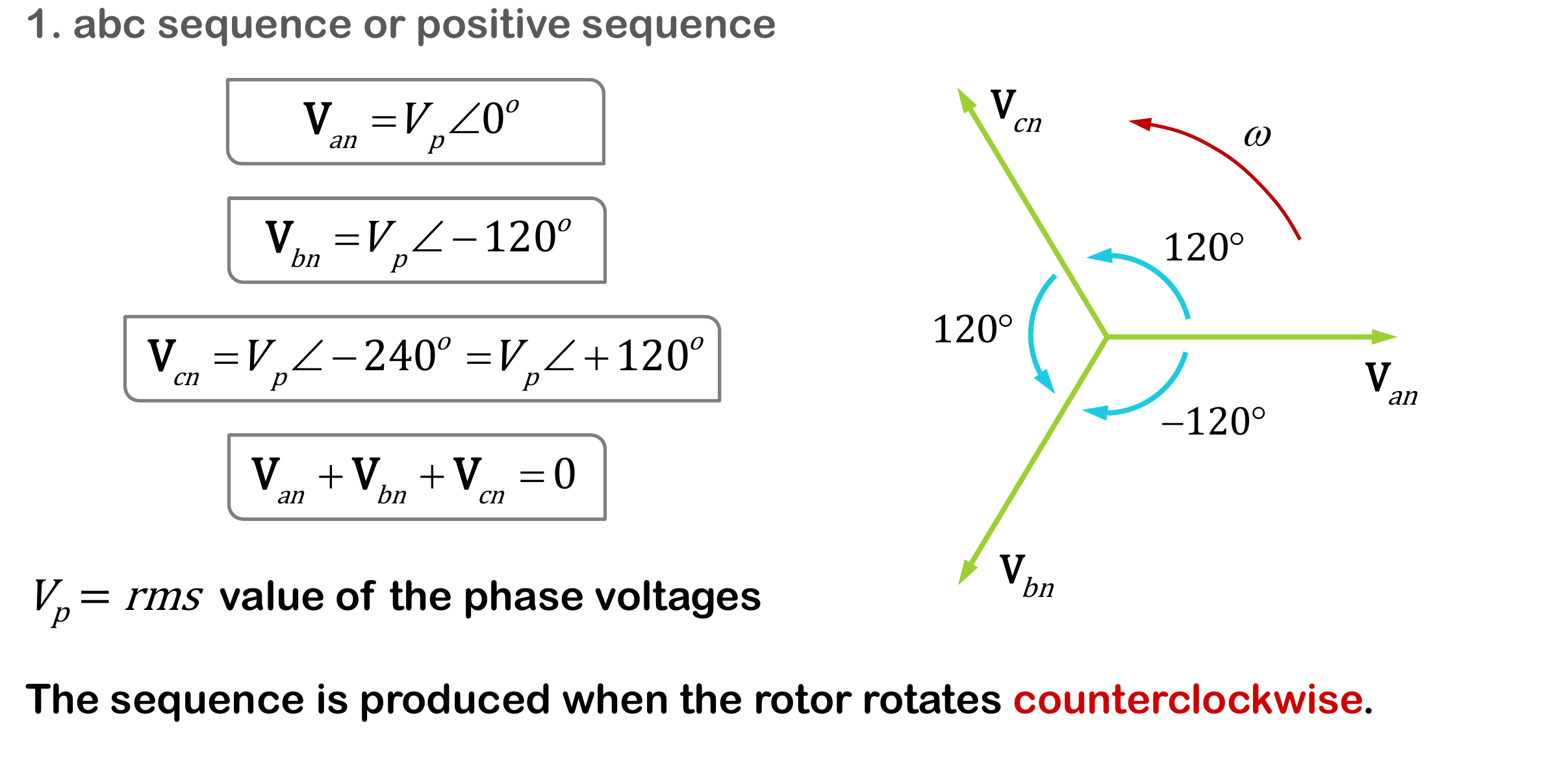
Two sequences ( is the rms phase voltage):
- abc (positive): , , (rotor turning anticlockwise)
- acb (negative): , , (rotor turning clockwise)
Balanced Loads
A balanced load has equal phase impedances: for Y, or for . They convert with . With Y or sources and loads there are four combinations: Y-Y, Y-, - and -Y.
Worked Example
Find the sequence of , , :
- phasors: , ,
- leads by , and leads by
- so the order is a, c, b: an acb sequence
The simplest arrangement to analyse is the Balanced Wye-Wye Connection.