Source
Adapted from my own handwritten and hand-typed notes from Year 1 to Year 3 of my EEE degree
Most domestic and industrial loads (motors, air conditioners, washing machines) are inductive and run at a low lagging power factor. Power factor correction is the process of raising the power factor without changing the voltage or current of the original load.
Method
A capacitor is connected in parallel with the inductive load. The capacitor current leads the voltage by and cancels part of the lagging load current, so the supply current gets smaller and moves closer to the voltage.
Parallel Capacitor Correction
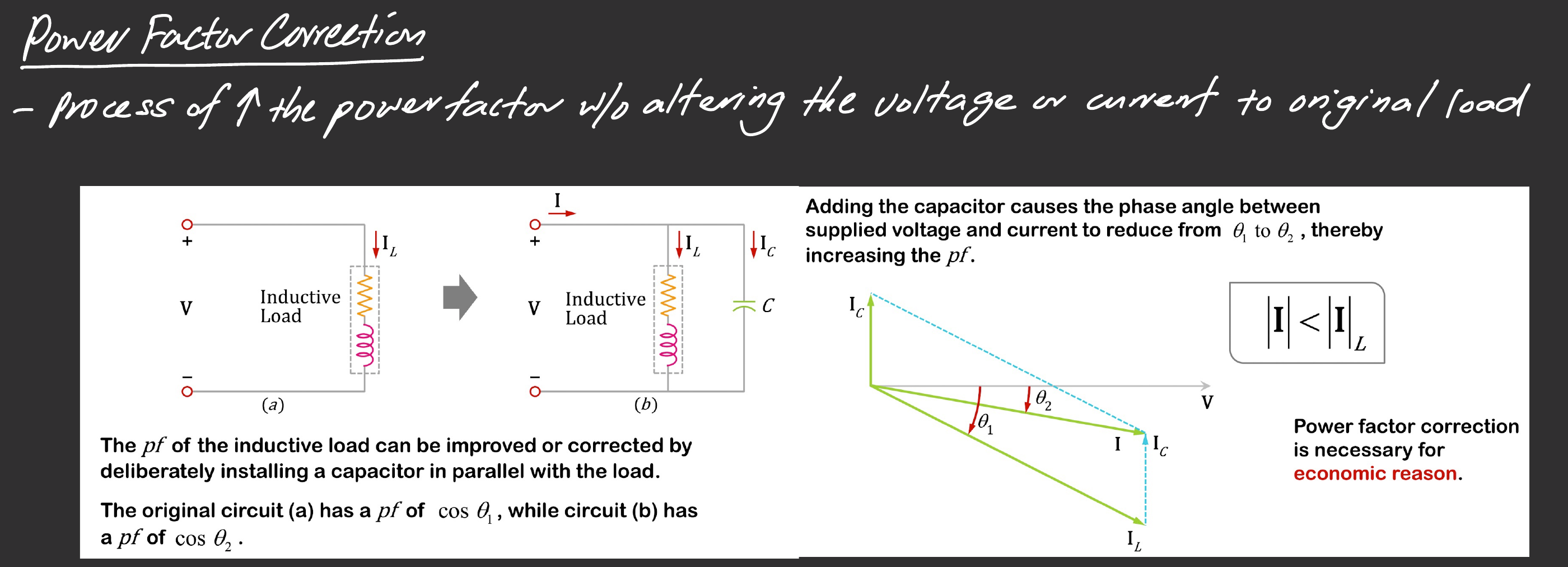
Effects:
- the phase angle falls from to , so rises from to
- the supply current falls,
- the real power of the load is unchanged
- smaller current means smaller line losses and cable sizes, so correction is done for economic reasons
Capacitor Size
From the power triangle, with fixed:
To correct a leading (capacitive) load, an inductor would be added instead, with .
Worked Example
A load on a 120 V rms, 60 Hz line absorbs 4 kW at 0.8 lagging pf. Find to raise the pf to 0.95:
- , so VAR
- , so VAR
- VAR
- F
Check with currents: A, and A.