Source
Adapted from my own handwritten and hand-typed notes from Year 1 to Year 3 of my EEE degree
Apparent Power and Power Factor
Writing average power with rms values:
Terms:
- apparent power , in volt-amperes (VA)
- power factor , between 0 and 1
- power factor angle , which is also the angle of the load impedance
Impedance Triangle and Load Types
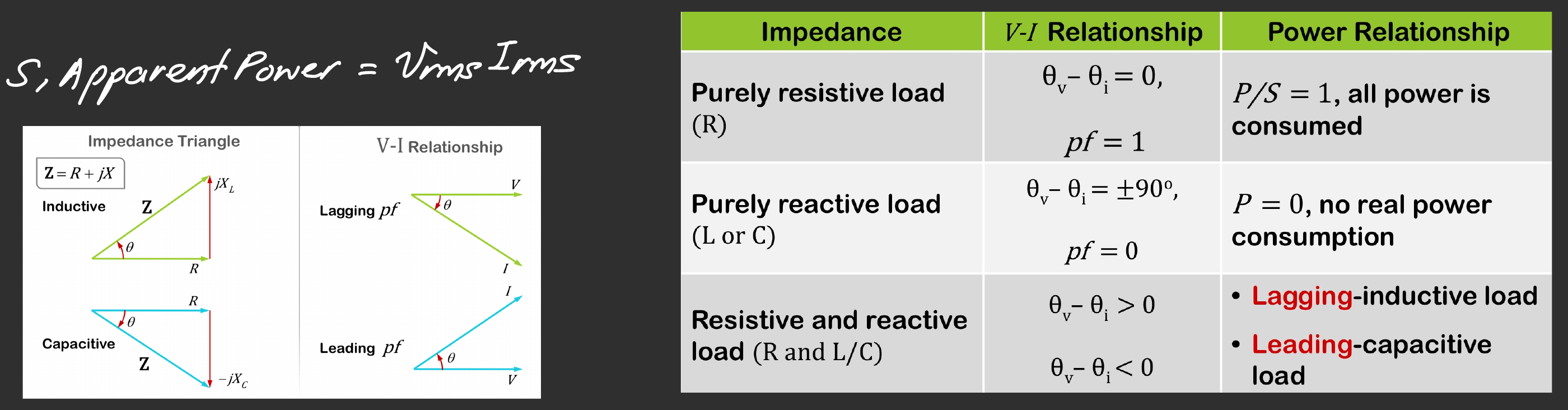
| Load | Angle | pf | Power |
|---|---|---|---|
| Purely resistive | 1 | , all power consumed | |
| Purely reactive | 0 | ||
| Inductive (R and L) | lagging (current lags) | ||
| Capacitive (R and C) | leading (current leads) |
Complex Power
Complex power collects all the power information of a load in one complex number:
Power Triangle
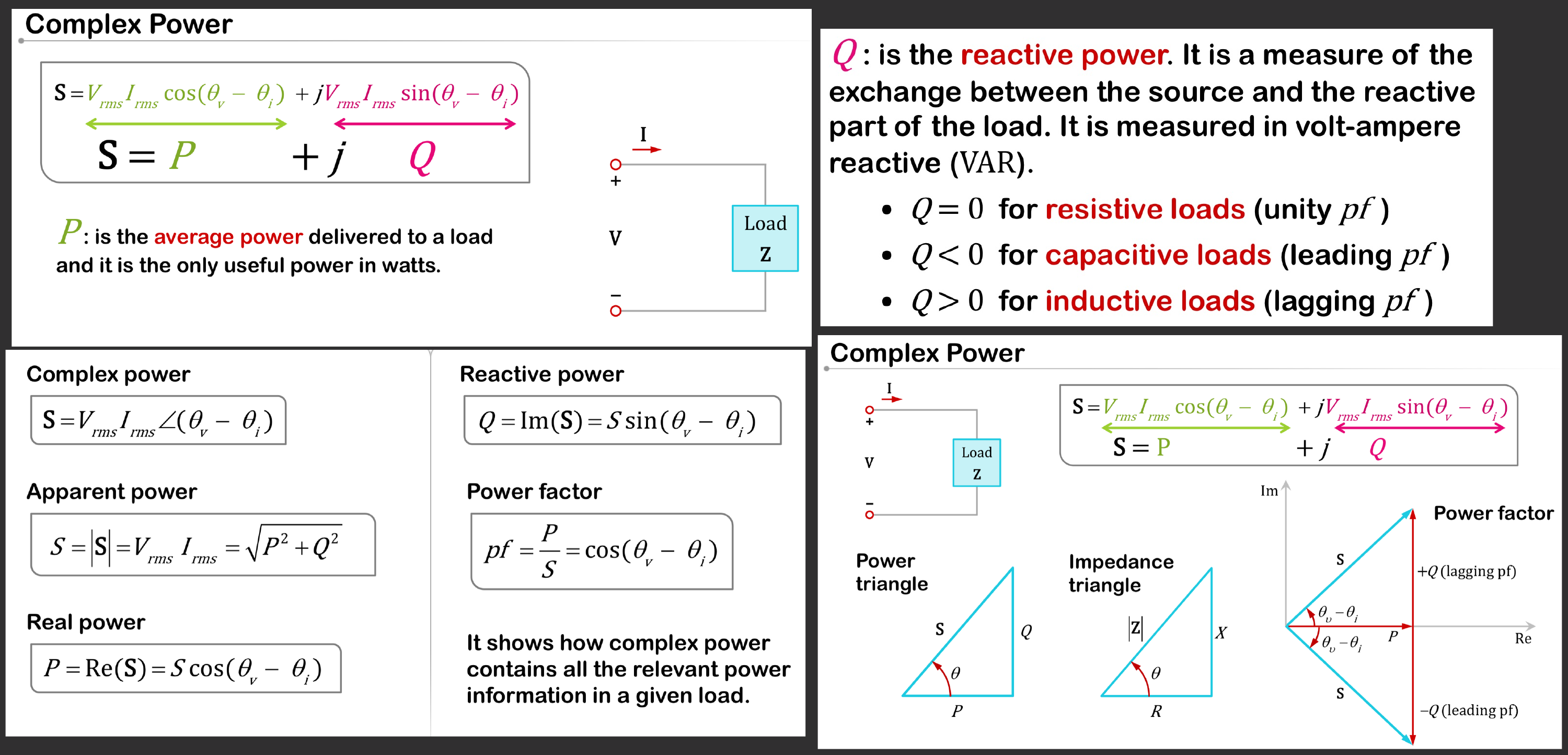
Parts:
- real (average) power in watts, the only useful power
- reactive power in VAR, the energy swapped back and forth between source and the reactive part of the load
- apparent power in VA
- the power triangle (, , ) has the same shape and angle as the impedance triangle (, , )
Conservation of AC Power
For a source feeding loads (in series or parallel), . Complex, real and reactive power are all conserved (apparent power is not, since magnitudes do not simply add).
Worked Example
V and A:
- and
- VA, so VA
- W and VAR
- leading, and (capacitive)
Finding the Load Elements
If V and A, then VA, leading, and . This is 25.98 in series with a capacitor of F.
A low lagging pf is fixed by Power Factor Correction.