Source
Adapted from my own handwritten and hand-typed notes from Year 1 to Year 3 of my EEE degree
In practice usually only the load changes while the rest of the circuit stays fixed. Thevenin's theorem lets the fixed part be replaced by a simple equivalent so the circuit does not need to be re-analysed each time.
Statement
A linear two-terminal circuit can be replaced by a voltage source in series with a resistor :
- is the open-circuit voltage at terminals a-b,
- is the input resistance at the terminals when all independent sources are turned off
Finding R_Th
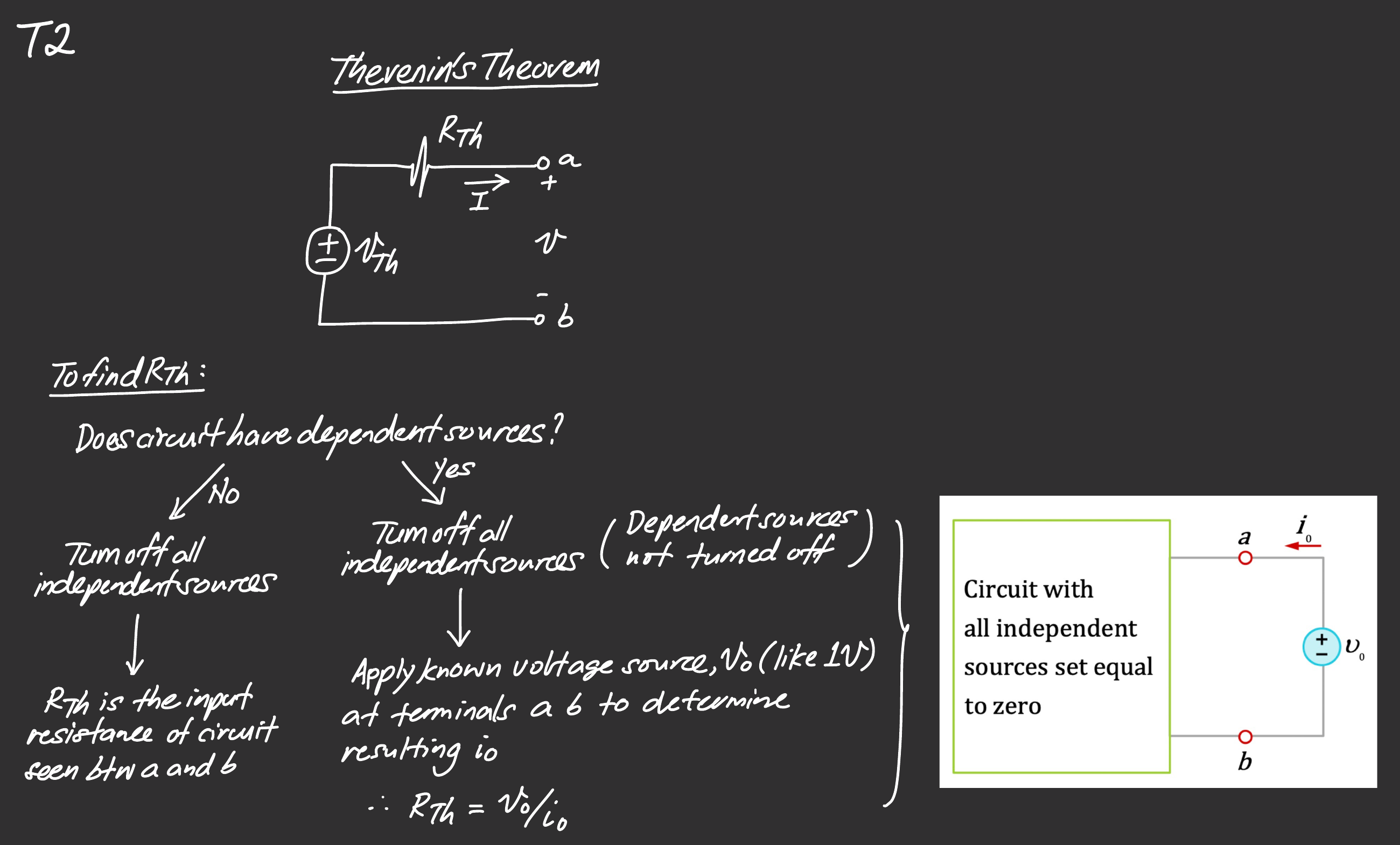
Two cases:
- no dependent sources: turn off all independent sources and find the equivalent resistance seen between a and b using series and parallel rules
- with dependent sources: turn off only the independent sources (dependent sources stay), apply a test source at a-b, then
- the test source can be a voltage source V (measure ) or a current source A (measure )
- with dependent sources can even come out negative, meaning the circuit supplies power
After finding , find with the load removed (no current flows at a-b).
Using the Equivalent
With a load connected:
Open-Circuit and Short-Circuit Tests
can also be found from two measurements on the original circuit:
where is the current that flows when a and b are shorted. This links directly to Norton's Theorem.
Worked Example
A 32 V source with 4 in series feeds a node that has 12 to ground and a 2 A source into it, then 1 to terminal a:
- : short the 32 V and open the 2 A, so
- : nodal at the middle node, , so V and V (no current in the 1 )
- for : A