Source
Adapted from my own handwritten and hand-typed notes from Year 1 to Year 3 of my EEE degree
Kirchhoff's two laws, together with Ohm's law, are enough to analyse any lumped circuit. They are the base of nodal analysis (KCL) and mesh analysis (KVL).
Circuit Topology
Terms used:
- branch: a single two-terminal element such as a source or resistor
- node: a point where two or more branches connect (all points joined by plain wire are one node)
- loop: a closed path that does not pass through any node twice
- mesh: a loop that does not contain any other loop inside it
- number of meshes: for branches and nodes
Nodes in an Example Circuit
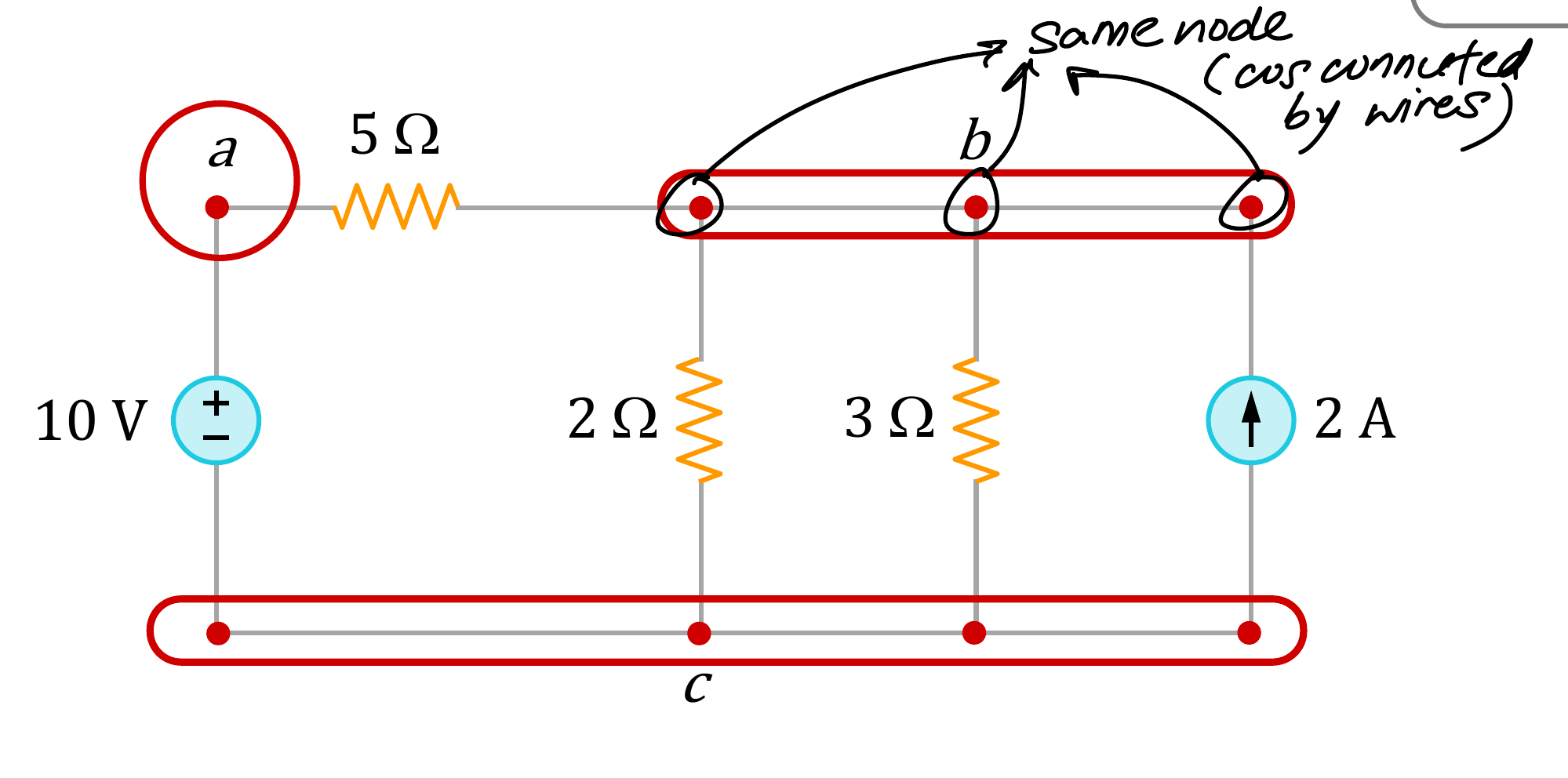
The circuit above has 5 branches and 3 nodes (a, b, c), so meshes. Elements are in series if they exclusively share one node (same current), and in parallel if they connect to the same two nodes (same voltage).
Kirchhoff's Current Law (KCL)
The algebraic sum of currents entering any node is zero:
KCL comes from conservation of charge. A consequence is that two different current sources cannot be placed in series.
Kirchhoff's Voltage Law (KVL)
The algebraic sum of all voltages around any closed loop is zero:
KVL comes from conservation of energy. A consequence is that two different voltage sources cannot be placed in parallel.
Sign habit (going clockwise around the loop):
- entering the terminal of an element is a voltage drop, written as
- entering the terminal of a source is a voltage rise, written as
Worked Example
A loop has a 12 V source, a 4 resistor, a dependent source , a 4 V source and a 6 resistor where . Going clockwise:
Substituting gives , so A and V.