Source
Adapted from my own handwritten and hand-typed notes from Year 1 to Year 3 of my EEE degree
An element is the basic building block of a circuit, and a circuit is an interconnection of elements. Elements are split into passive and active types.
Passive and Active Elements
| Type | Can generate energy? | Examples |
|---|---|---|
| Passive | No | resistors, capacitors, inductors |
| Active | Yes | generators, batteries, op-amps |
The most important active elements are voltage sources and current sources, which can be independent or dependent.
Independent Sources
An ideal independent source gives a specified voltage or current that does not depend on any other element.
Behaviour:
- an ideal voltage source keeps its terminal voltage fixed and supplies whatever current the circuit needs
- an ideal current source keeps its current fixed and develops whatever voltage the circuit needs
- a current source arrow must show the current direction
Dependent Sources
An ideal dependent (controlled) source has a value controlled by a voltage or current elsewhere in the circuit. It is drawn as a diamond. Dependent sources are used to model transistors and amplifiers.
Four Dependent Source Types
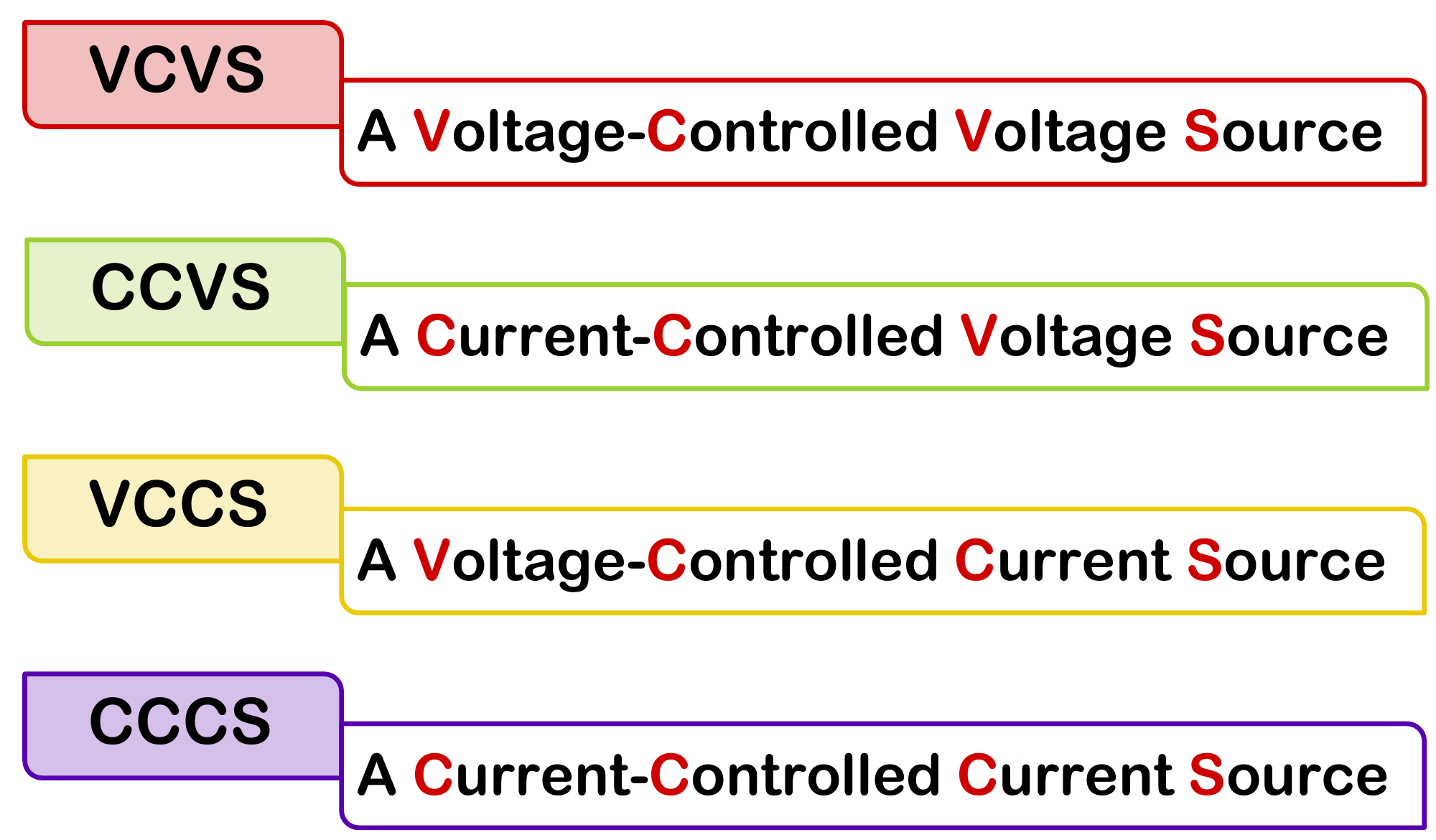
The four types:
- VCVS: , voltage controlled by a voltage
- CCVS: , voltage controlled by a current
- VCCS: , current controlled by a voltage
- CCCS: , current controlled by a current
For example, a CCVS labelled supplies volts, where is the current through some other element. The units follow the source type, not the controlling variable.
The simplest passive element is the resistor, described by Ohm's Law.