Source
Adapted from my own handwritten and hand-typed notes from Year 1 to Year 3 of my EEE degree
Circuit analysis works with four basic quantities: charge, current, voltage and power. Once these are clear, the elements in Circuit Elements and Sources can be described by how they relate them.
Charge and Current
Charge is measured in coulombs (C). An electron carries C. Current is the rate of flow of charge, measured in amperes (A):
Key points:
- 1 A means 1 C of charge passing a cross section per second
- conventional current flows opposite to electron flow
- DC is a current that stays constant with time (written ), AC varies sinusoidally with time (written )
- a current of A in one direction is the same as A in the other direction
Voltage
Voltage is the energy needed to move a unit charge from point a to point b, measured in volts (1 V = 1 J/C):
The sign marks the terminal assumed to be at higher potential. If V, there is a 9 V drop from a to b (or a 9 V rise from b to a), and . Voltage is always across an element or between two points.
Power and Energy
Power is the rate of absorbing or supplying energy, in watts (W):
Passive Sign Convention
The passive sign convention is satisfied when the current enters the element through its terminal. Then means power absorbed. If the current leaves through the terminal, , and a negative value means the element is supplying power.
Absorbing and Supplying Power
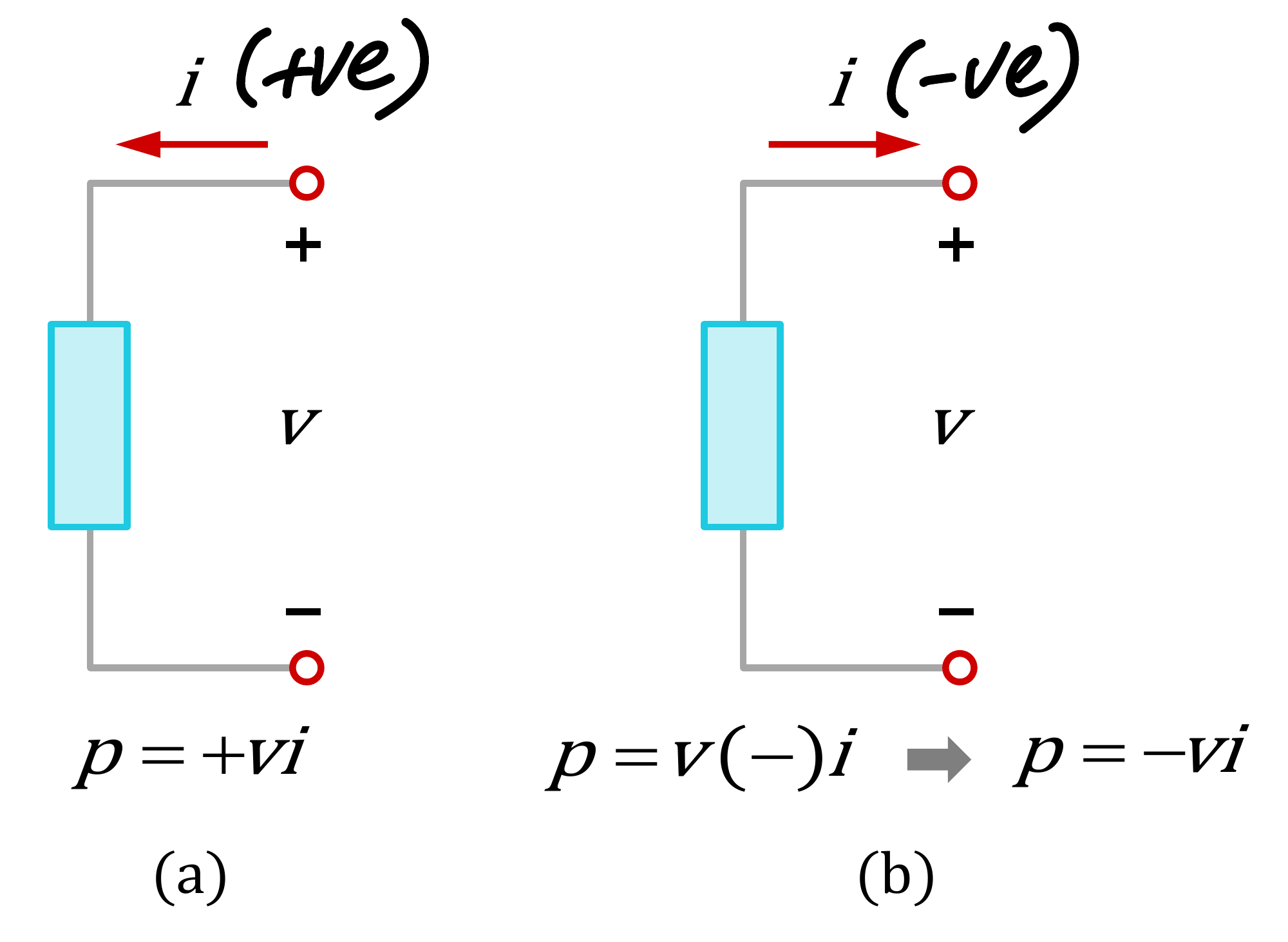
Rules to remember:
- absorbed power is positive, supplied power is negative
- a battery delivering energy has negative power
- in any circuit, total power supplied plus total power absorbed is zero (conservation of energy)
Worked Example
A 20 V source carries 5 A out of its terminal, a 12 V element carries 5 A into its terminal and an 8 V element carries 6 A into its terminal. A dependent source (with A) carries 1 A out of the terminal of the same 8 V:
- W (supplied)
- W (absorbed)
- W (absorbed)
- W (supplied)
Check: .