- a digital image is stored as a 2D array of pixels
- each pixel stores one intensity value
- image is a function sampled on a rectangular grid
- spatial variables and indicates the spatial distances
- pixel are discrete
- pixels are influenced by its neighbours
- local operations use nearby pixel to compute a new values
2-D Impulse Signal
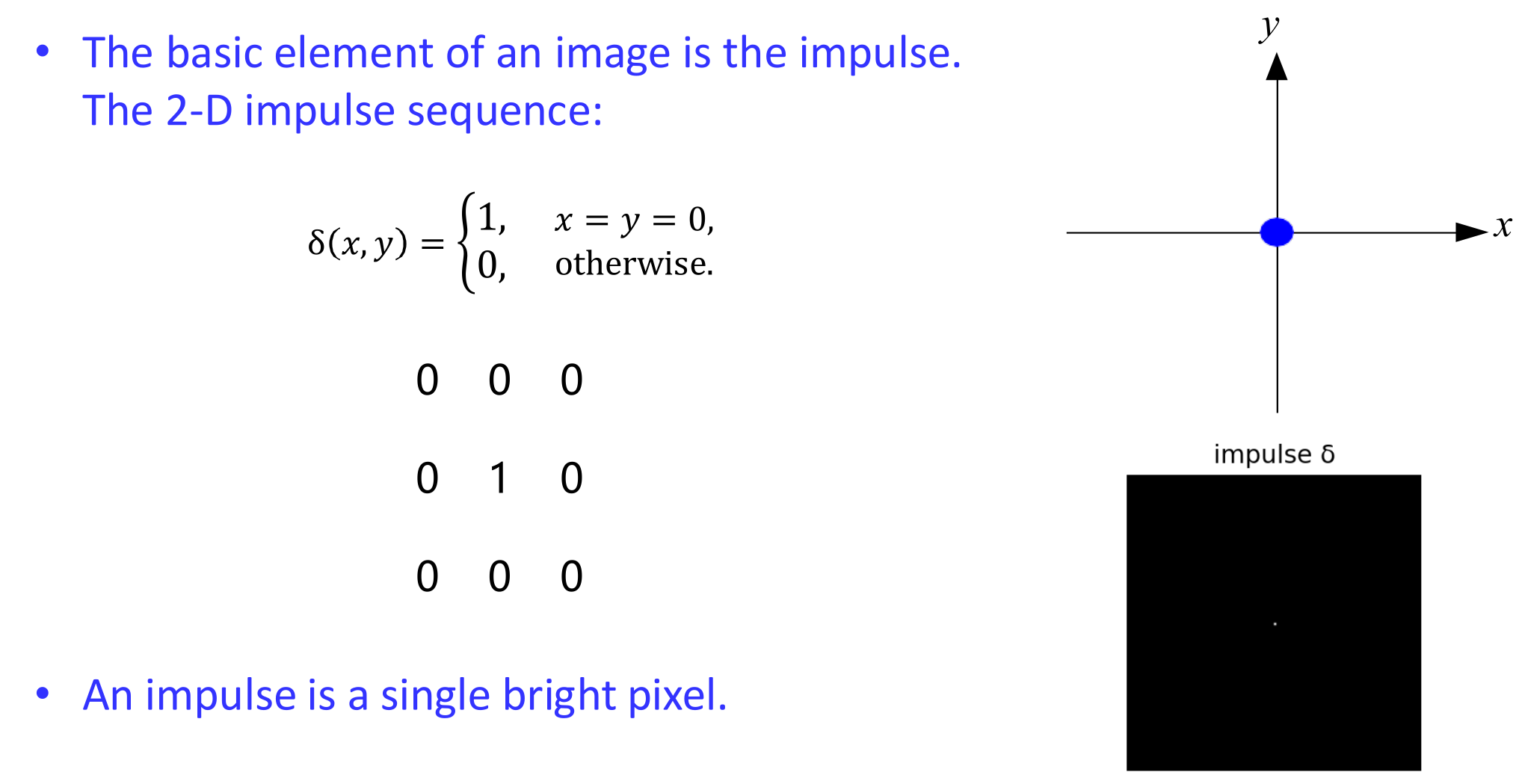
We can represent every pixel as a shifted and scaled impulse. For example, a pixel at and with pixel intensity half of the brightest impulse pixel will be:
Where:
- represents the scaled pixel intensity, in our case above its
- and is the shifted impulse, where and
Building an Image from many Impulses
Any image can be represented by the sum of a number of shifted and scaled impulses:
The above equation is for an infintely wide and long image. However, for a finite image:
where:
- the size of image are bounded by 2 variables, and
Example
Question:
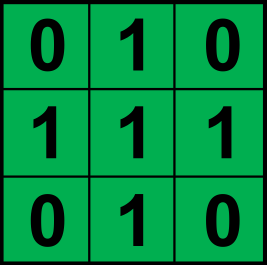
We have an input image . We wanna suppress the pixel random noise/smooth the image. We need to perform local average by taking the sum of the corresponding pixel with its 4 neighbour pixels in the input image (left, right, top, down).
Answer:
To express the sum of pixels:
where:
- represents the particular pixel we are trying to compute for, so its the center pixel
- represents the pixel directly above the pixel
This direct approach where we sum the pixels and then divide by the number of pixels to find the local average, is a more intuitive, hand-written process.
Convolution can be expressed as:
where:
- is the resulting pixel intensity in the output image at position
- represents the pixel values from the original image around position
- represents the specific multiplier (weight) assigned to each surrounding pixel
This is the general formula for Discrete 2D Spatial Convolution where we are convoluting between the input image and the sliding filter/kernel .
This convolution approach is a more generalised framework that is being used in softwares.
Impulse response can be expressed as:
The above equation representing the impulse response can also be expressed as such:
2-D Image Systems
The output of a 2-D system with an input can be expressed as:
Linear and Shift-Invariant Properties
Linearity:
3 factors required for Linearity:
- each input pixel appears only once
- each pixel are only to the first power
- each pixel are multiplied by a constant
Things that break Linearity
max, min, median, sorting, squaring, absolute value, thresholding, logarithm, gamma, histogram equalization, and clipping
Shift Invariance - the same processing applies to the whole image:
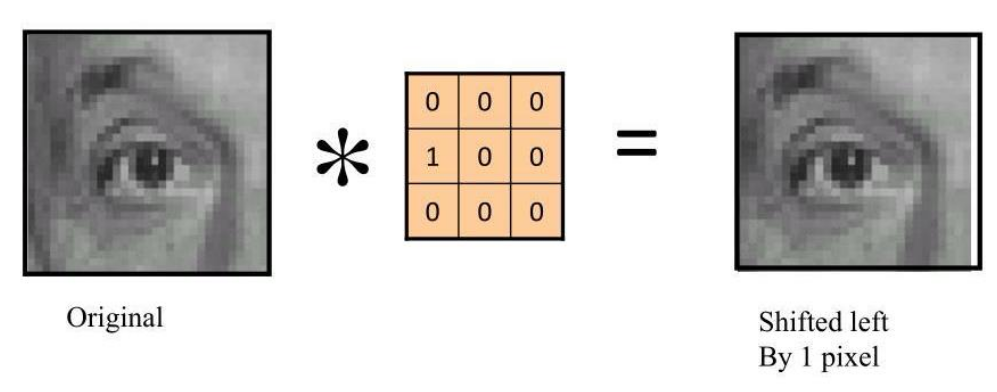
1 Factor required for Shift-invariance:
- the weights are the same at every pixel positions
Things that break Shift-Invariance
weights that change with position, adaptive filters, coordinate changes such as rotation or resizing, and border rules that alter the window near the edges
Linear and Shift-Invariant (LSI) Systems
- Linear + Shift Invariant = LSI System
- An LSI system is only characterised by its impulse response, defined as:
- For an LSI system, Convolution operation is defined as: