Source
Adapted from my own handwritten and hand-typed notes from Year 1 to Year 3 of my EEE degree
1-Bit Comparison
For two bits and :
| 0 | 0 | 1 | 0 | 0 |
| 0 | 1 | 0 | 0 | 1 |
| 1 | 0 | 0 | 1 | 0 |
| 1 | 1 | 1 | 0 | 0 |
So equality is an XNOR, see XOR XNOR Operations and Operator Precedence.
4-Bit Magnitude Comparator
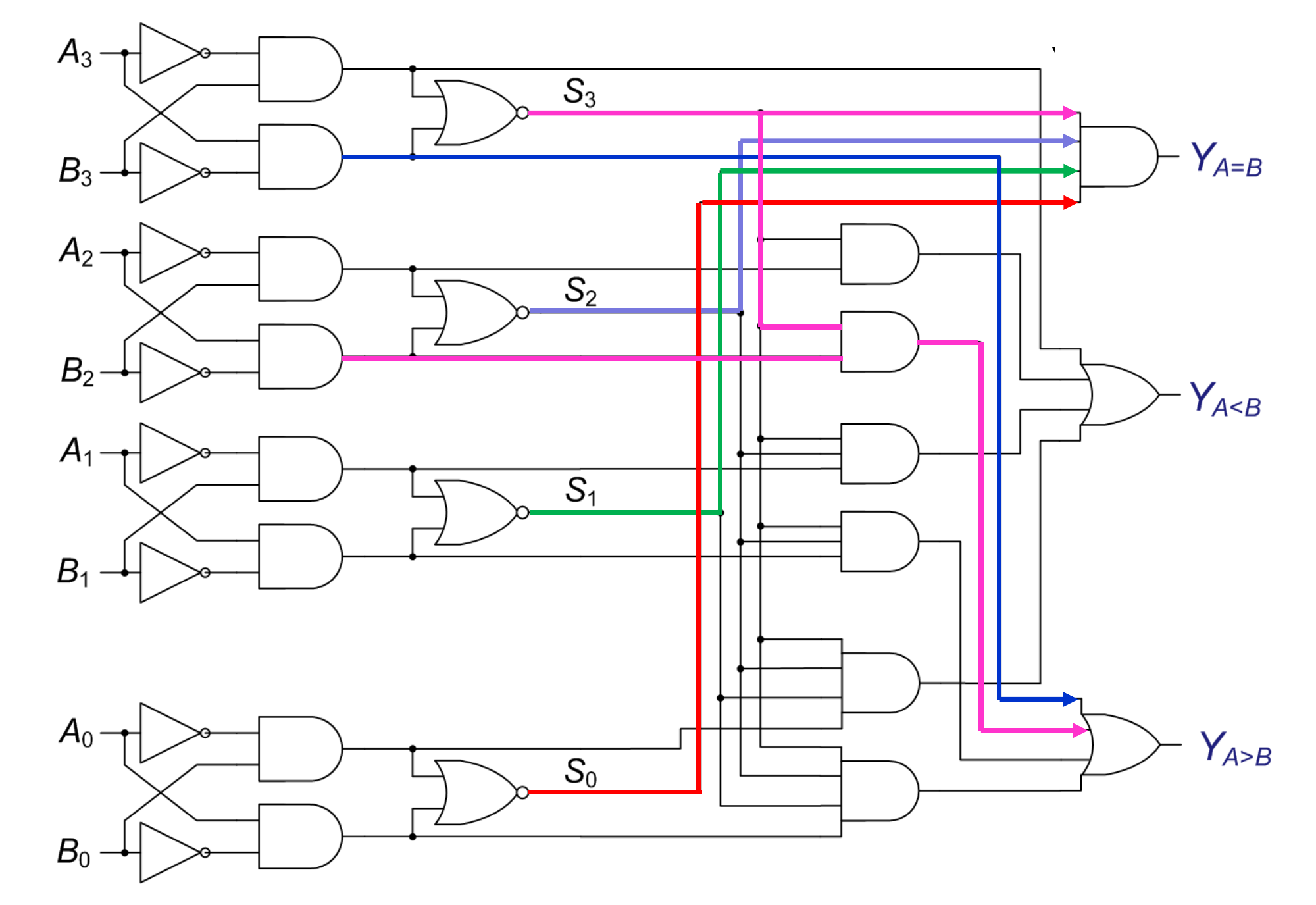
Inputs and . Outputs , , .
For each bit define the equality signal:
Equal only if every bit is equal:
when the first bit (from the MSB) that differs has , . That gives exactly four cases:
7485 Comparator and Cascading
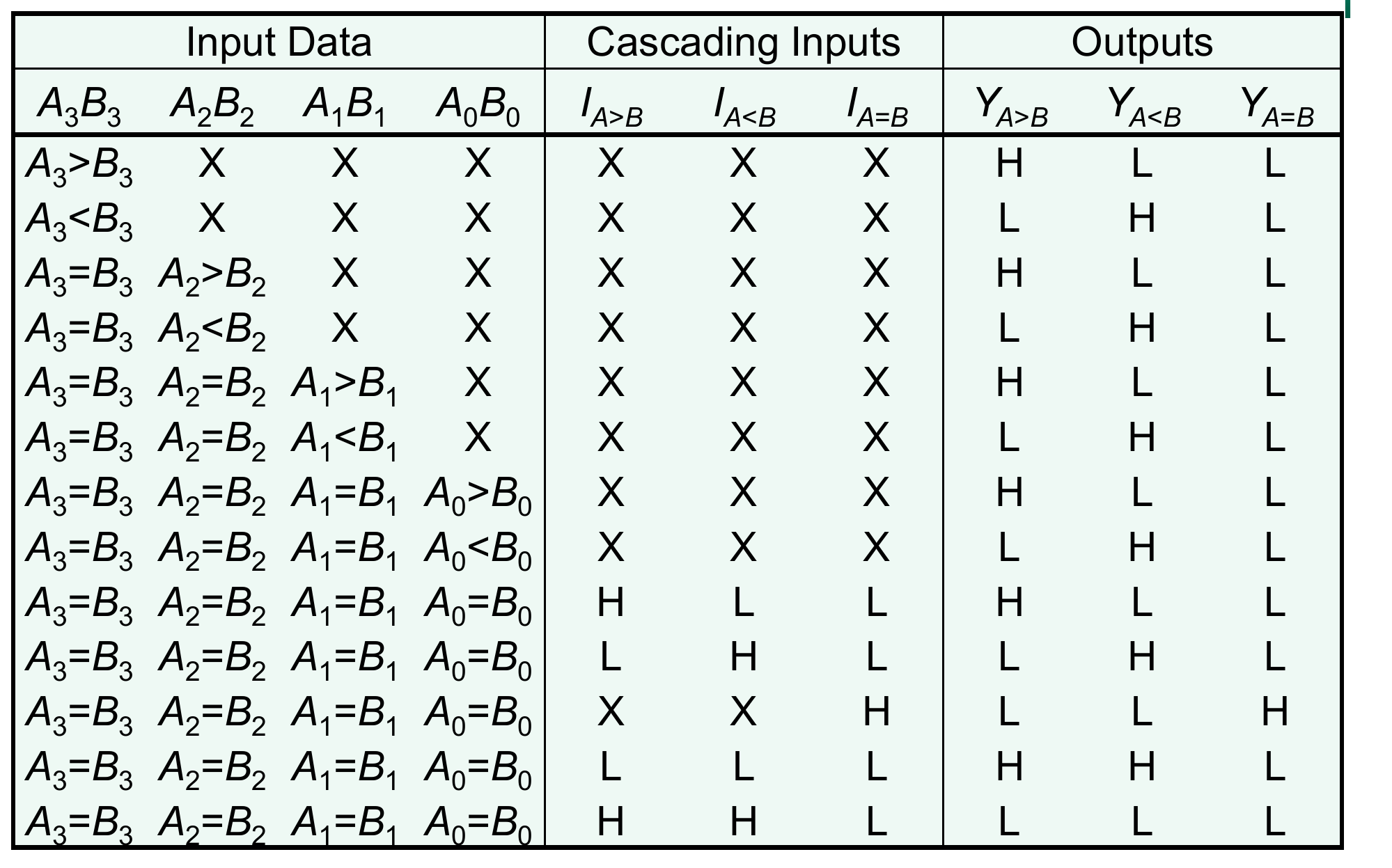
The 7485 is a 4-bit MSI comparator with three cascading inputs , , . These only matter when all four data bits are equal, then the outputs copy the cascading inputs.
Rules for use:
- for a single 4-bit comparison set and
- for 8 bits, feed the outputs of the low-order 7485 into the cascading inputs of the high-order 7485
- the high-order chip decides whenever its bits differ, and passes on the lower result only when they are equal
A spare cascading input can also act as an extra LSB. For example, to compare a 5-bit with 01011 on one 7485, put against 0101 and use to drive the cascading inputs: if the top bits are equal, means and means .