Source
Adapted from my own handwritten and hand-typed notes from Year 1 to Year 3 of my EEE degree
Half Adder
A half adder (HA) adds two single bits and and gives a sum and a carry .
| 0 | 0 | 0 | 0 |
| 0 | 1 | 1 | 0 |
| 1 | 0 | 1 | 0 |
| 1 | 1 | 0 | 1 |
A half adder alone cannot do multi-bit addition, because every column except the LSB has three bits to add: , and the carry from the column below.
Full Adder
A full adder (FA) adds , and a carry in , giving a sum and a carry out .
| 0 | 0 | 0 | 0 | 0 |
| 0 | 0 | 1 | 1 | 0 |
| 0 | 1 | 0 | 1 | 0 |
| 0 | 1 | 1 | 0 | 1 |
| 1 | 0 | 0 | 1 | 0 |
| 1 | 0 | 1 | 0 | 1 |
| 1 | 1 | 0 | 0 | 1 |
| 1 | 1 | 1 | 1 | 1 |
From the K-maps, is a checkerboard (odd function) and is the majority function:
Full Adder From Two Half Adders
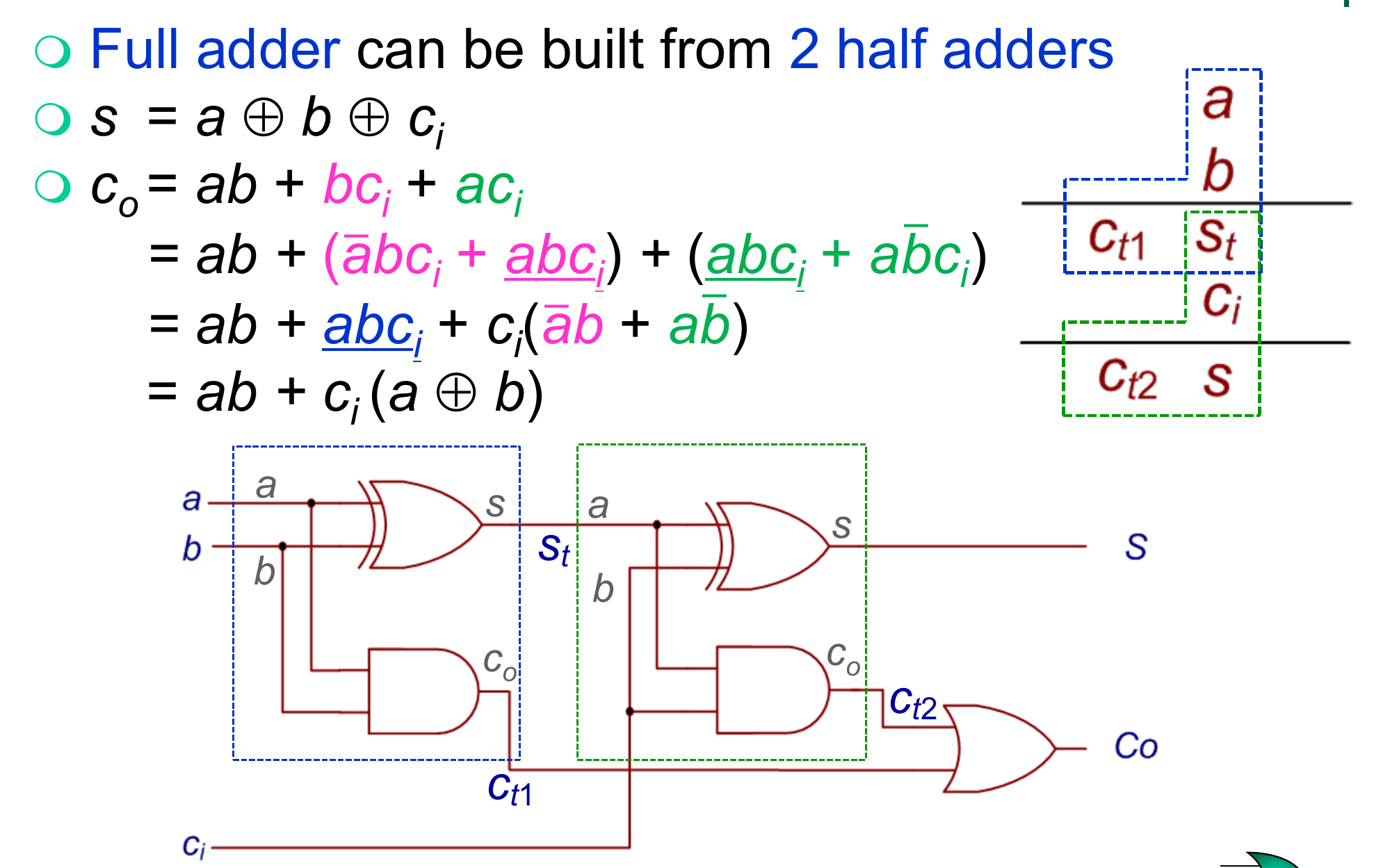
Rewrite the carry:
So the first HA makes and , the second HA adds to give and , and an OR gate combines the two carries.
Ripple Carry Adder
An n-bit ripple adder chains full adders. The carry out of bit is the carry in of bit , the LSB carry in is 0, and is the final carry out.
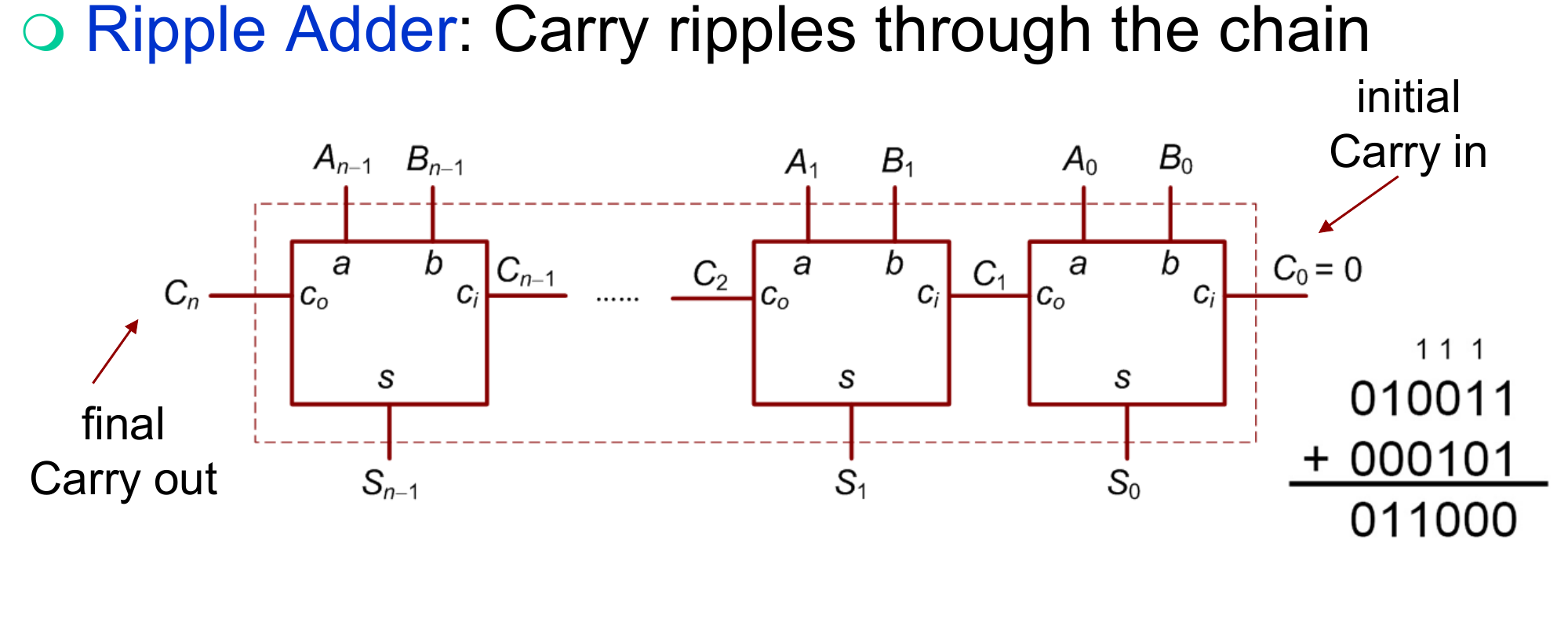
It is simple but slow: in the worst case the carry must ripple through every stage before the MSB sum is valid. For example produces a carry in bit 0 that must pass through all four stages to give . With about 2 gate delays per carry stage, the delay grows linearly with . A Carry-Look-Ahead Adder removes this chain.
MSI Adders
Examples: 74183 (1-bit full adder), 7482 (2-bit), 7483 and 74283 (4-bit adders with internal look-ahead carry), 74182 (4-bit look-ahead carry generator), 4008 (CMOS 4-bit). Two 4-bit adders are cascaded for 8-bit addition by connecting of the low chip to of the high chip.