Source
Adapted from my own handwritten and hand-typed notes from Year 1 to Year 3 of my EEE degree
Programmable Logic Devices
A PLD contains an array of AND gates followed by an array of OR gates, with programmable connections. Since any function can be written as a sum of products, a PLD can implement any logic function within its size. Input buffers give both the true and complemented form of every input.
Three common types, which differ in which array is fixed:
| Device | AND array | OR array |
|---|---|---|
| PAL (Programmable Array Logic) | programmable | fixed |
| PLA (Programmable Logic Array) | programmable | programmable |
| PROM (Programmable ROM) | fixed (full decoder) | programmable |
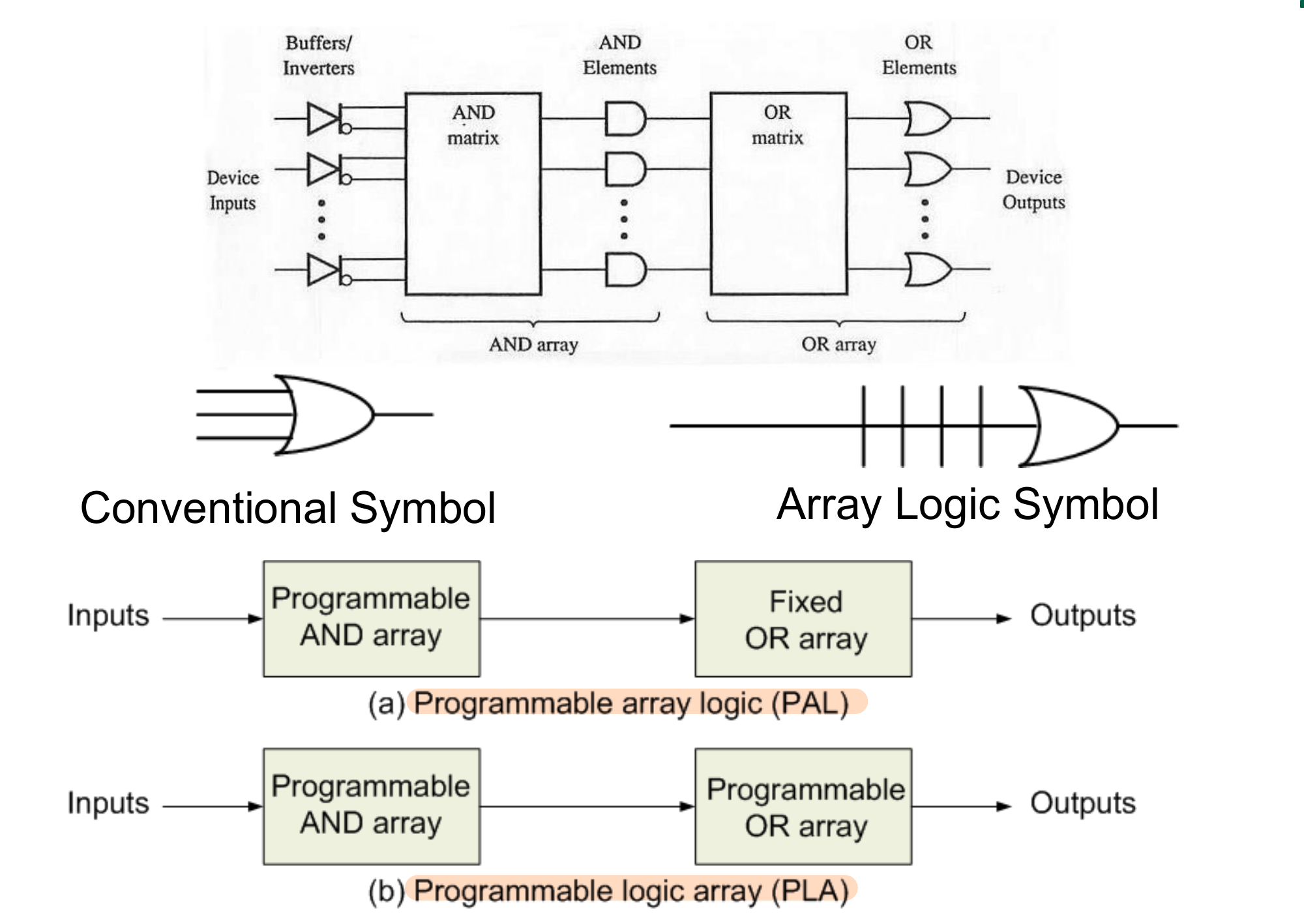
In array logic notation, one line into a gate stands for all its inputs. A dot is a fixed connection and an x is a fuse-programmable connection (the fuse is blown when the connection is not needed).
PAL
Features:
- each AND gate has programmable connections for inputs (every input and its complement)
- each OR gate has a fixed number of product terms, set at manufacture
- product terms cannot be shared between outputs, because the OR array is fixed
So each output must be minimised to fit within its number of product terms. If an output needs a term that another output also uses, it must be built again on a separate AND gate.
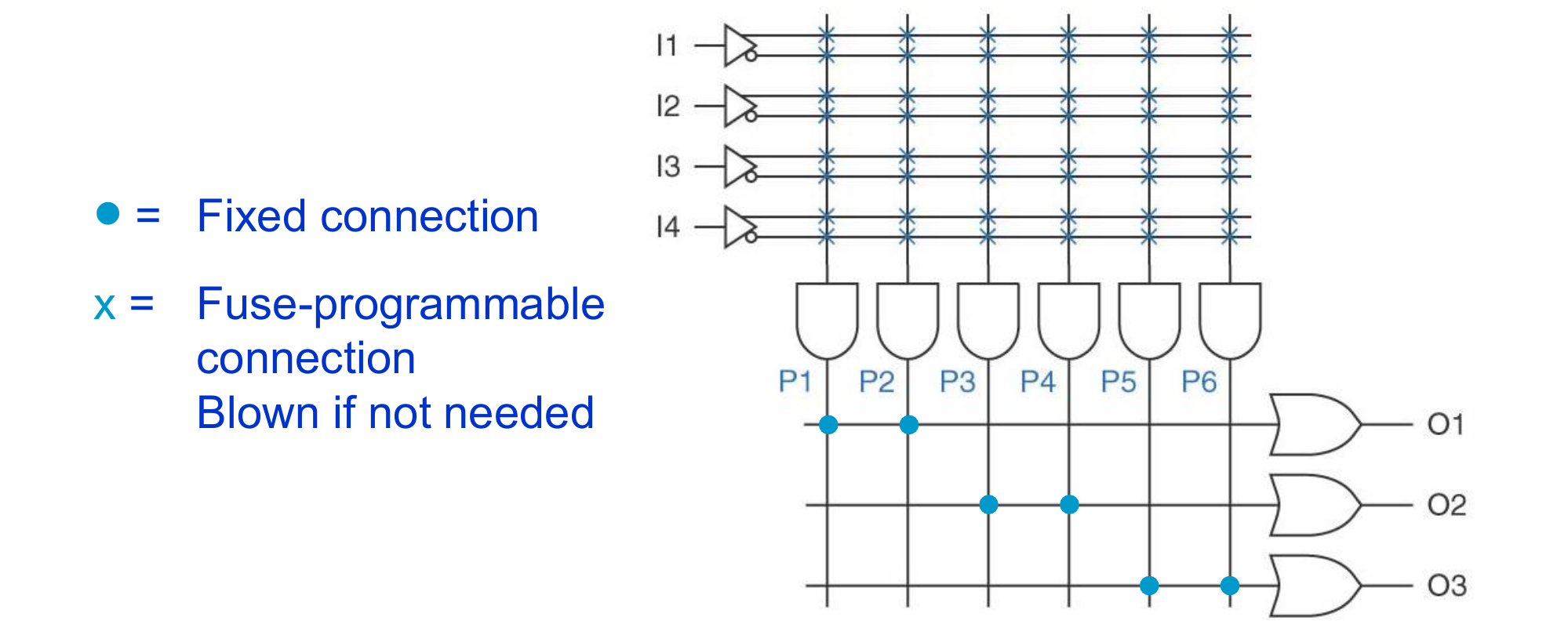
Example (each OR gate takes up to 3 terms):
PLA
Features:
- both arrays are programmable
- the number of product terms per output is chosen by the user
- product terms can be shared between outputs
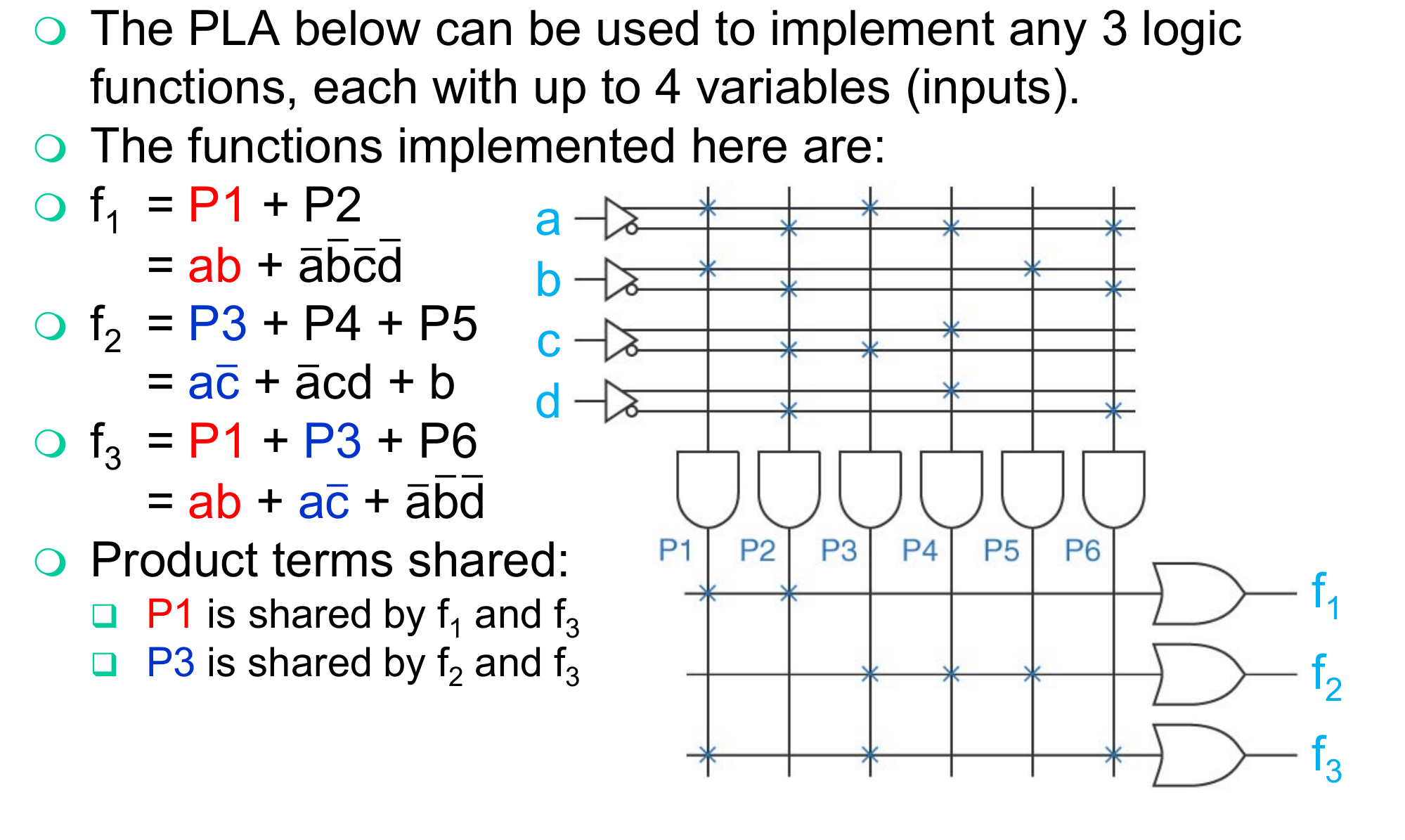
Since a PLA has a fixed total number of AND gates, the goal is to minimise the total number of distinct product terms across all outputs, not the size of each term. Sometimes a non-minimal grouping for one function is better because it reuses a term that another function already needs.
Advantages of PLDs
Benefits:
- one PLD replaces many SSI/MSI packages, so the PCB is smaller and cheaper
- fewer parts are easier and cheaper to assemble
- design time is much shorter than for an ASIC or full custom IC
- reprogrammable devices allow easy design changes
- fewer components give better reliability