Source
Adapted from my own handwritten and hand-typed notes from Year 1 to Year 3 of my EEE degree
Definitions
Key terms:
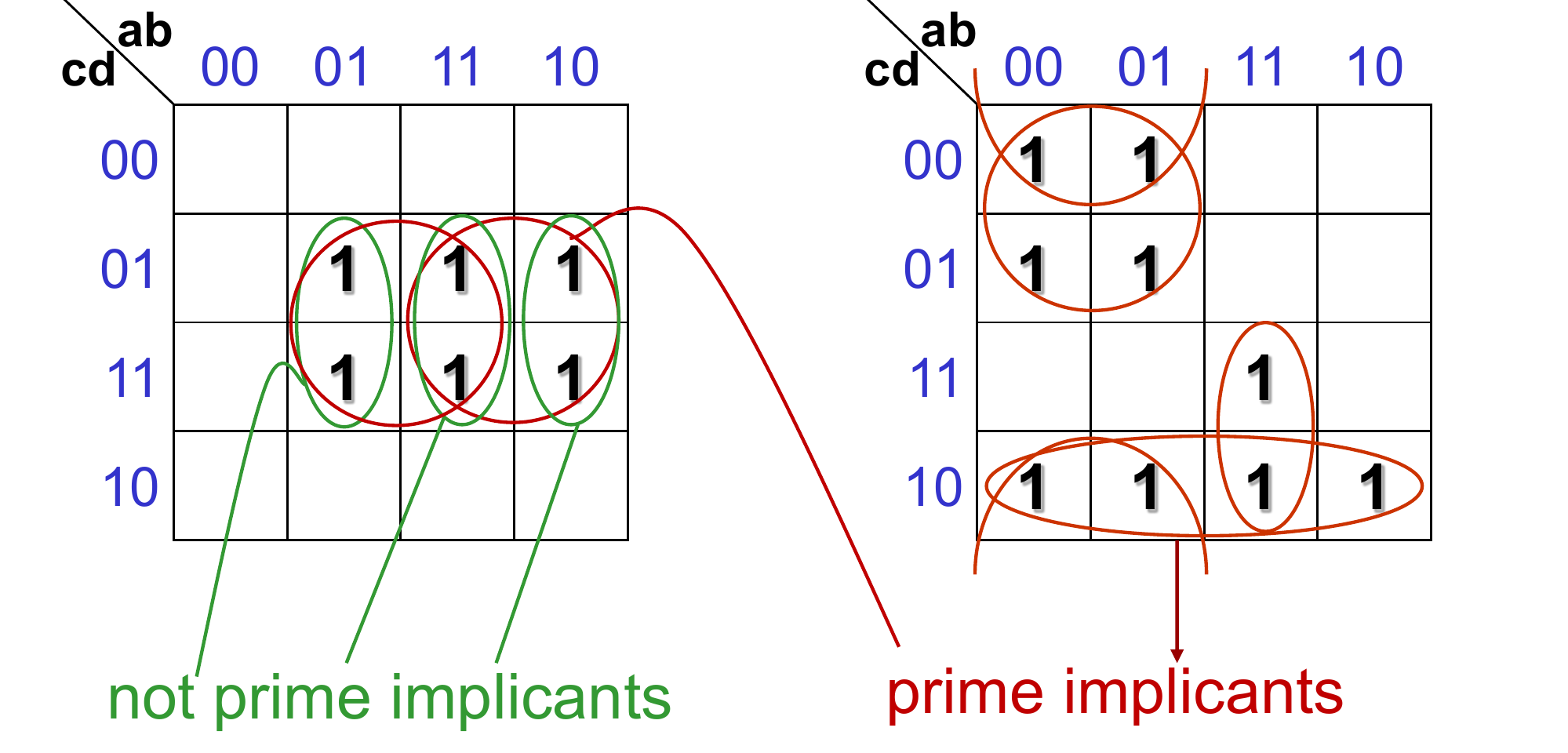
- implicant: any valid group of 1s on the K-map, i.e. any product term that implies the function
- prime implicant (PI): an implicant that cannot be combined into a larger group, i.e. a group covering the largest possible block of adjacent squares
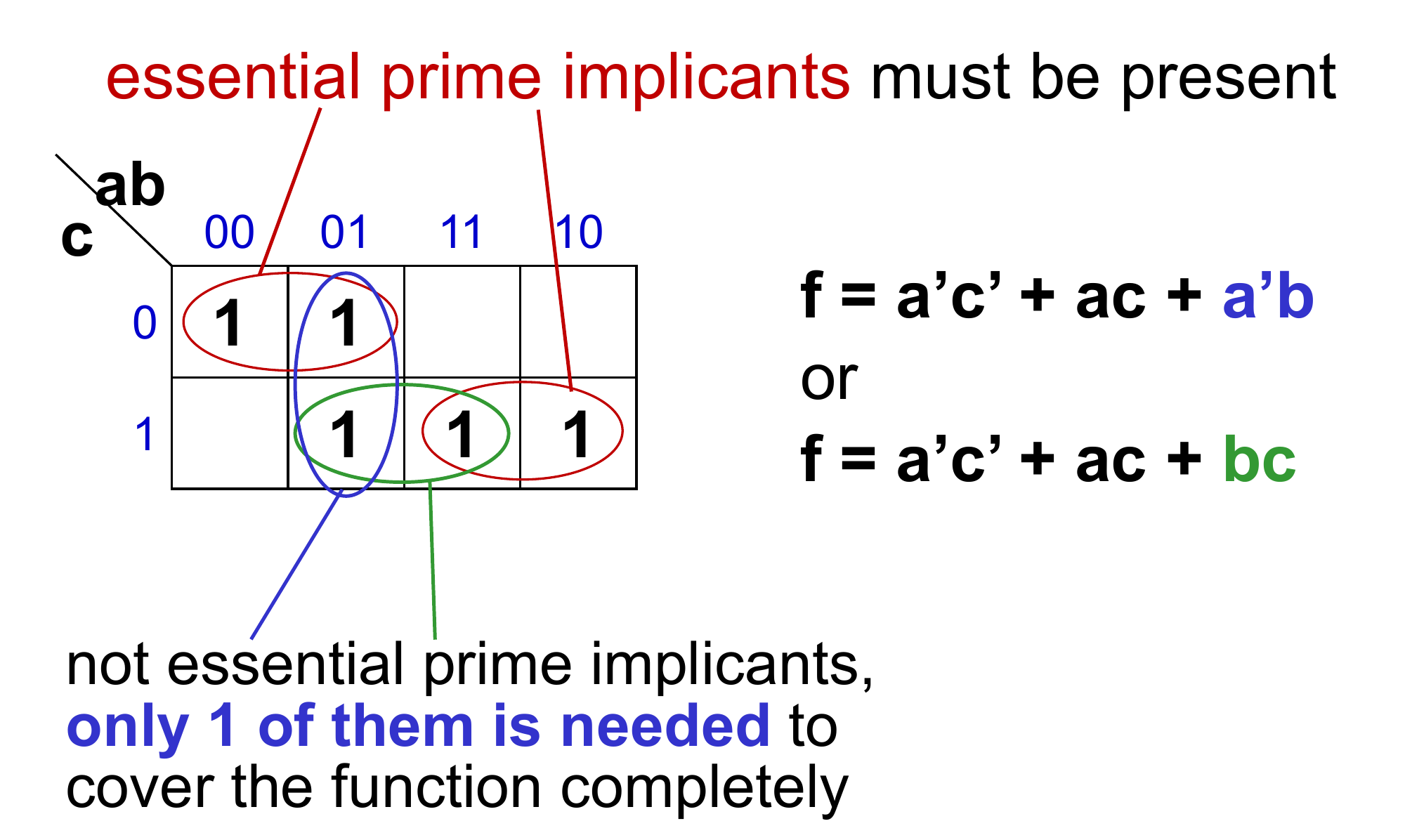
- essential prime implicant (EPI): a prime implicant that covers at least one minterm that no other prime implicant covers
A function is covered when every 1 square is inside at least one group. The same map can be covered in many ways, so a function can be written in many equivalent SOP forms.
A prime implicant may contain 1, 2, 4, 8 or even 16 minterms.
Minimized Function
A minimized logic function contains:
- all essential prime implicants (these must appear)
- the fewest extra prime implicants needed to cover the remaining 1s
When there is a choice of extra prime implicants, there can be several different but equally minimal answers.
Procedure
Steps:
- mark every prime implicant (largest possible groups)
- find 1s covered by only one PI, those PIs are essential
- add the cheapest PIs that cover what is left
- write one product term per group and OR them
Worked Example
:
| 00 | 01 | 11 | 10 | |
|---|---|---|---|---|
| 0 | 1 | 1 | 1 | 0 |
| 1 | 0 | 0 | 1 | 1 |
- is only in (covers ), so is essential
- is only in (covers ), so is essential
- is still uncovered and can go in either or , both prime, neither essential
A common mistake is to circle as a pair inside a bigger possible group, or to keep a group that is fully covered by other groups. Both give a correct but non-minimal answer.
Undefined input rows make bigger groups possible, see Don't-Care Conditions.