Source
Adapted from my own handwritten and hand-typed notes from Year 1 to Year 3 of my EEE degree
Why NAND and NOR
In CMOS, NAND and NOR gates are the natural (inverting) gates and they are faster and smaller than AND and OR, which need an extra inverter stage. So two-level SOP and POS designs are usually built entirely from NAND or NOR gates.
SOP as NAND-NAND
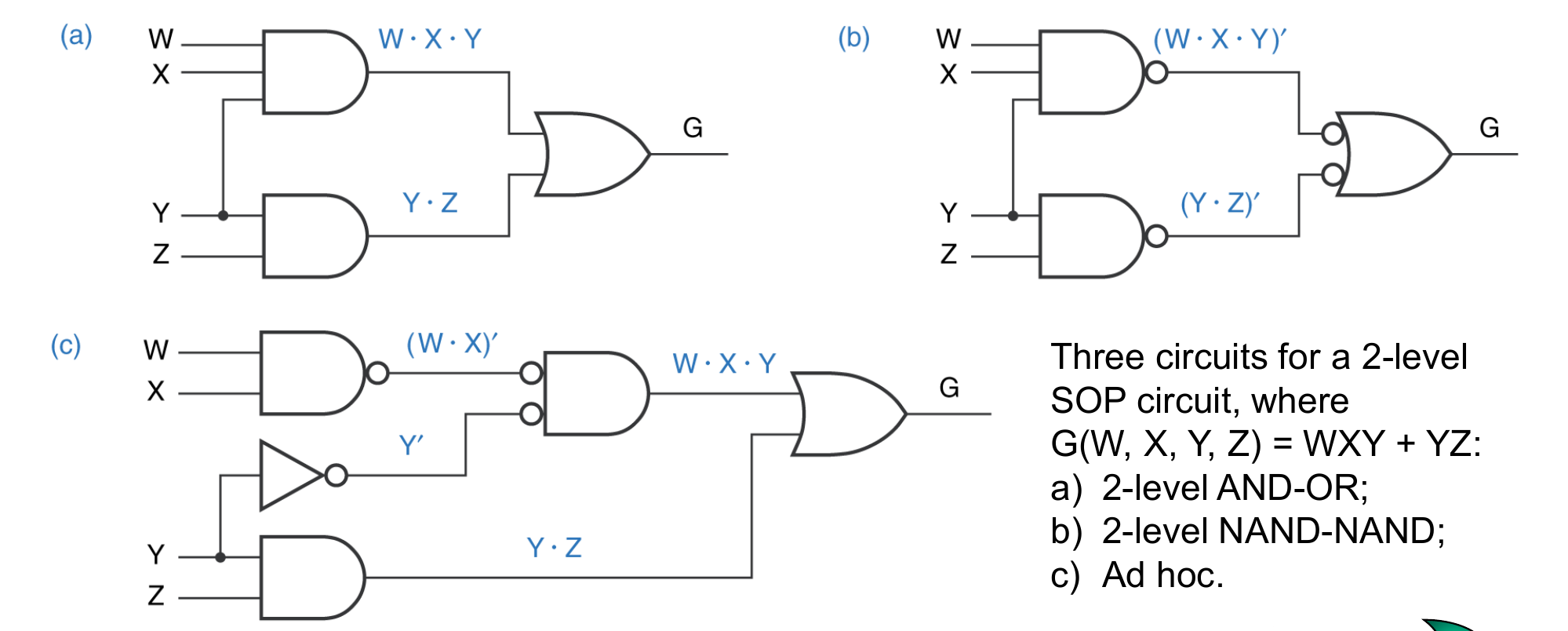
An SOP expression is a 2-level AND-OR circuit. Apply a double inversion and DeMorgan:
So every AND gate becomes a NAND and the output OR gate becomes a NAND as well. The OR of inverted inputs is the same as a NAND (bubbles at the OR inputs cancel the bubbles at the AND outputs).
POS as NOR-NOR
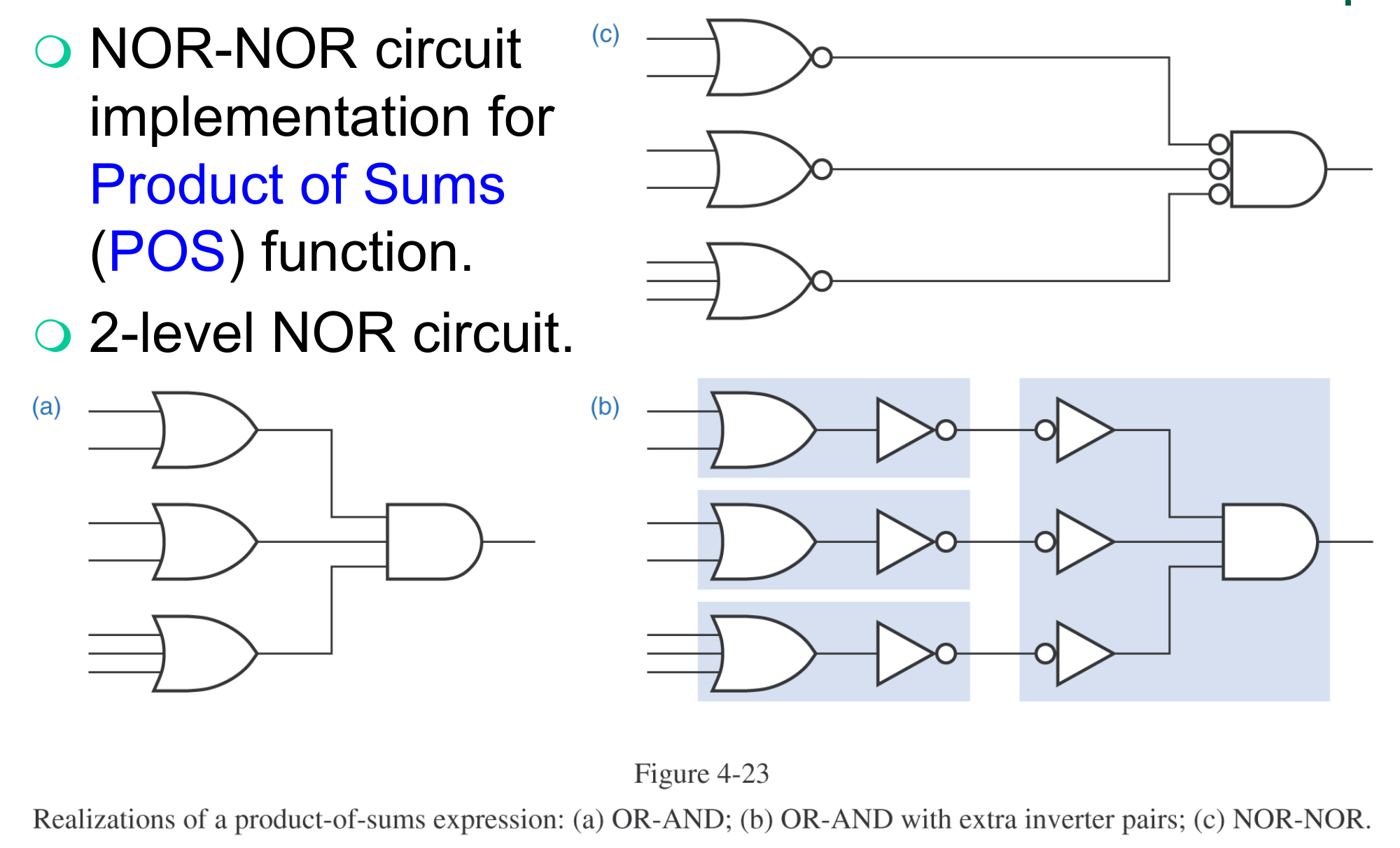
A POS expression is a 2-level OR-AND circuit. By the dual argument:
So every OR gate becomes a NOR and the output AND gate becomes a NOR.
Practical Points
Things to watch:
- a single literal that feeds the second level directly must be inverted, because it skips the first-level gate
- NAND-NAND only works directly for SOP, NOR-NOR only for POS
- the minimised SOP or POS from a K-map gives the smallest 2-level circuit