Source
Adapted from my own handwritten and hand-typed notes from Year 1 to Year 3 of my EEE degree
The Laplace transform turns the integro-differential equations of a circuit into algebraic equations in a complex frequency variable . This gives the total response (natural plus forced) in one step and builds in the initial conditions automatically.
Definition
Notes:
- has units of 1/s (frequency)
- the lower limit (just before ) captures impulses and jumps at , so initial conditions are included
- for is ignored, so this is the one-sided (unilateral) transform
- is called a transform pair
Basic Pairs from the Definition
- unit step:
- exponential:
- impulse:
- cosine, using Euler:
Properties and Transform Table
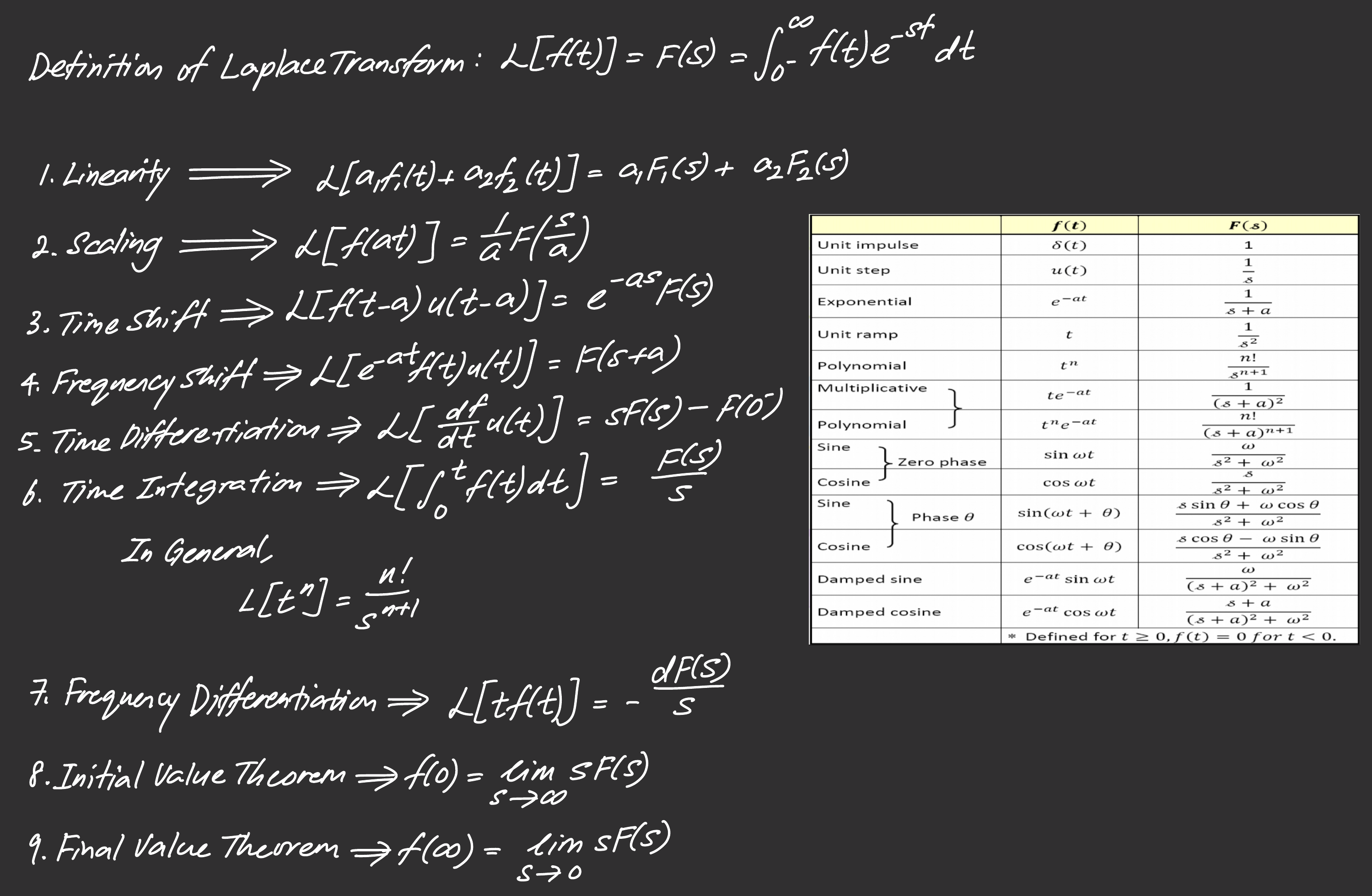
| Property | Time domain | s-domain |
|---|---|---|
| Linearity | ||
| Scaling | ||
| Time shift | ||
| Frequency shift | ||
| Time differentiation | ||
| Second derivative | ||
| Time integration | ||
| Frequency differentiation |
Useful results: and .
Initial and Final Value Theorems
The final value theorem only holds if actually settles, meaning all poles of are in the left half plane.
Solving a Differential Equation
Solve with , :
Getting back to the time domain uses the Inverse Laplace Transform in Circuits.