Source
Adapted from my own handwritten and hand-typed notes from Year 1 to Year 3 of my EEE degree
When two coils are linked by a common magnetic field, a changing current in one coil induces a voltage in the other. This is mutual inductance , measured in henrys. Each coil still has its own self-inductance, described in Inductors.
Coupled Coils
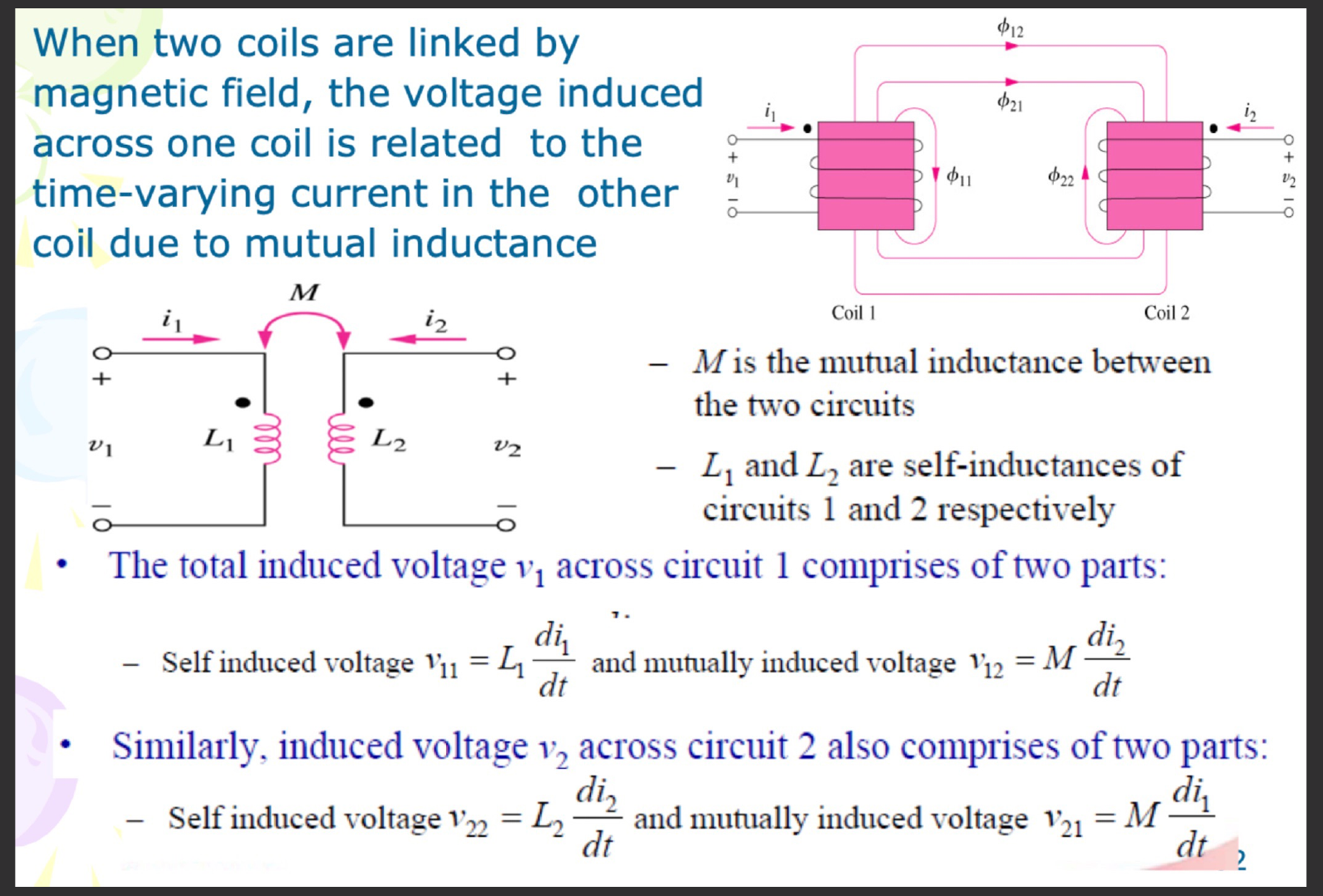
Induced Voltages
Each coil voltage has a self part and a mutual part:
Dot Convention
The sign of the mutual term is set by the dots on the coils:
- if a current enters the dotted terminal of one coil, the mutual voltage in the other coil is positive at its dotted terminal
- if a current leaves the dotted terminal, the mutual voltage is negative at the other dotted terminal
- when writing mesh equations, check each mutual term separately with this rule
Coupling Coefficient
The coupling coefficient measures how tightly the coils are linked:
means perfect coupling (all flux links both coils) and means no coupling.
T-Equivalent Circuit
For two coils with a common terminal and both currents entering the dots:
So the coupled coils can be replaced by a T network of three uncoupled inductors: in arm 1, in arm 2 and in the shared leg. This removes the need for the dot rule.