Source
Adapted from my own handwritten and hand-typed notes from Year 1 to Year 3 of my EEE degree
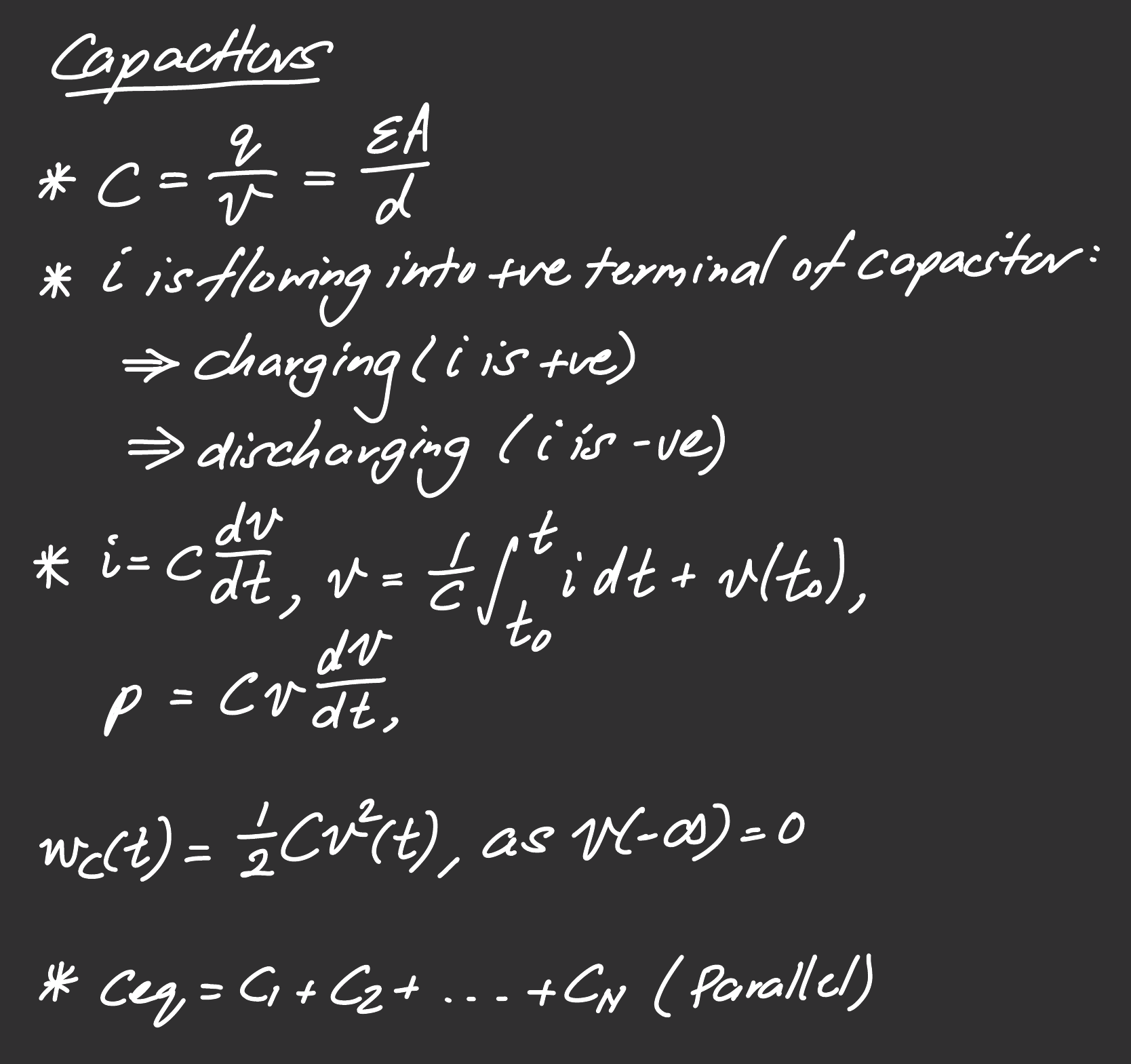
A capacitor is a passive element that stores energy in its electric field. It is two conducting plates separated by an insulator (dielectric).
Capacitance
Capacitance is the ratio of charge on a plate to the voltage between the plates, measured in farads (F):
where is the permittivity of the dielectric, the plate area and the plate spacing. Practical values are in pF, nF and F.
Capacitor Formula Summary
Current-Voltage Relationship
With current flowing into the terminal (positive means charging, negative means discharging):
Power and Energy
using . For example, 1 F with 10 V across it stores J.
Important Behaviour
Properties:
- if is constant, , so a capacitor acts as an open circuit to DC (after a long time)
- the faster changes, the larger the current
- the voltage across a capacitor cannot change instantly, since that would need infinite current and power
- the current through a capacitor can jump
- an ideal capacitor does not dissipate energy, it only stores and returns it
Series and Parallel
Capacitors combine like conductances (opposite to resistors):
Series capacitors carry the same charge, so and the voltage splits in inverse ratio to capacitance.
Worked Example
A 100 F capacitor carries mA with :
So mV and V.
The magnetic counterpart is the inductor.