Source
Adapted from my own handwritten and hand-typed notes from Year 1 to Year 3 of my EEE degree
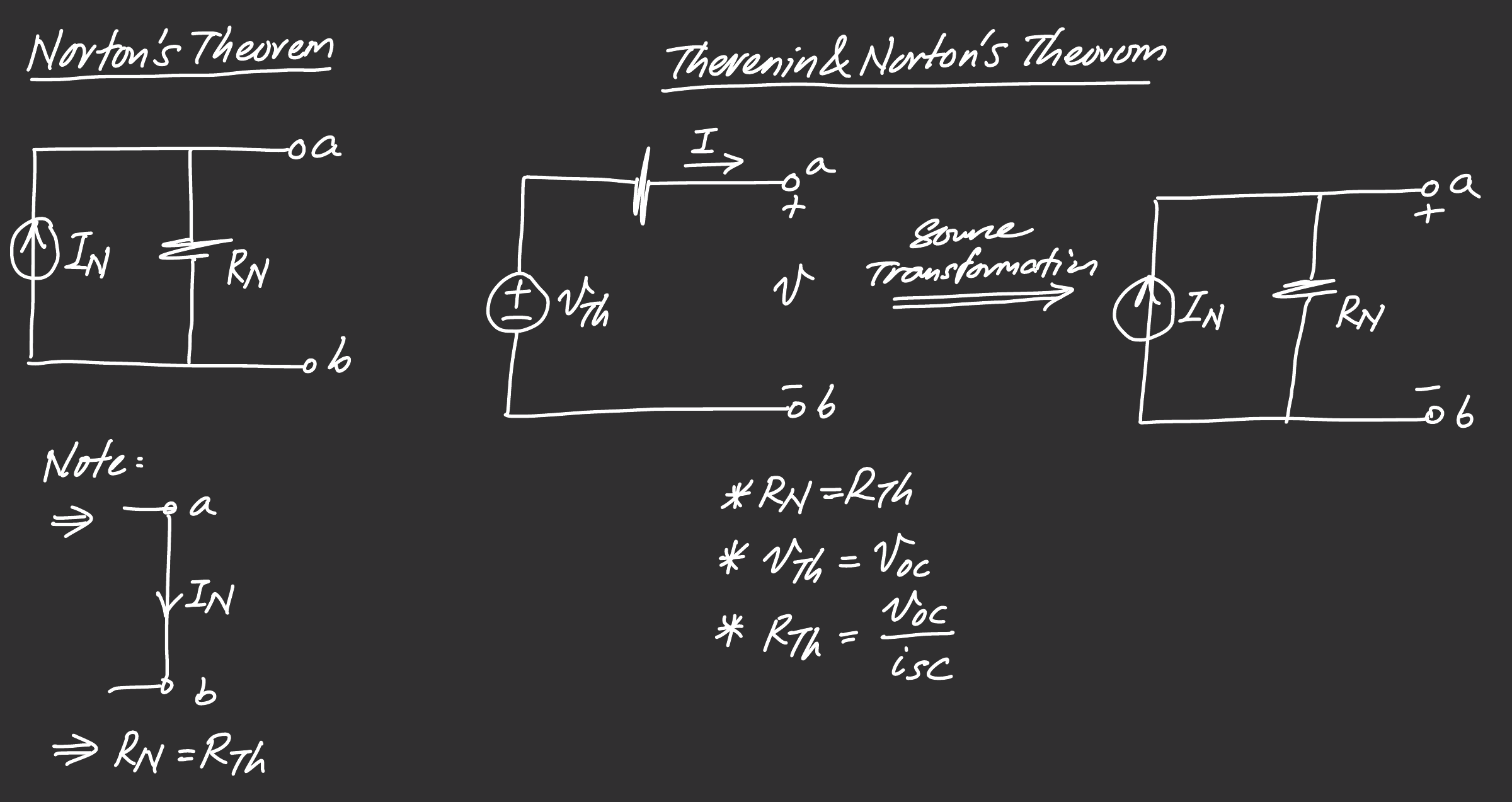
Norton's theorem states that a linear two-terminal circuit can be replaced by a current source in parallel with a resistor :
- is the short-circuit current flowing from a to b,
- is the input resistance with independent sources off, found exactly like , so
Norton Equivalent Circuit
Link to Thevenin
The Norton and Thevenin equivalents are a source transformation of each other:
So any two of , and give the third. In practice:
- find whichever of or is easier, plus
- or find both and when the circuit has dependent sources, avoiding a test source
Worked Example
A source of 12 V in series with 4 is connected across 12 , and terminal a is taken across the 12 :
- short a-b: the 12 is bypassed, so A
- check: V, which matches the divider V
The Thevenin or Norton form is the starting point for Maximum Power Transfer.