Source
Adapted from my own handwritten and hand-typed notes from Year 1 to Year 3 of my EEE degree
Some resistor networks are neither series nor parallel, for example a bridge. The wye-delta (Y-) transformation swaps a three-terminal Y (or T) network for an equivalent (or ) network, after which normal series and parallel rules can be used.
Y and Delta Networks
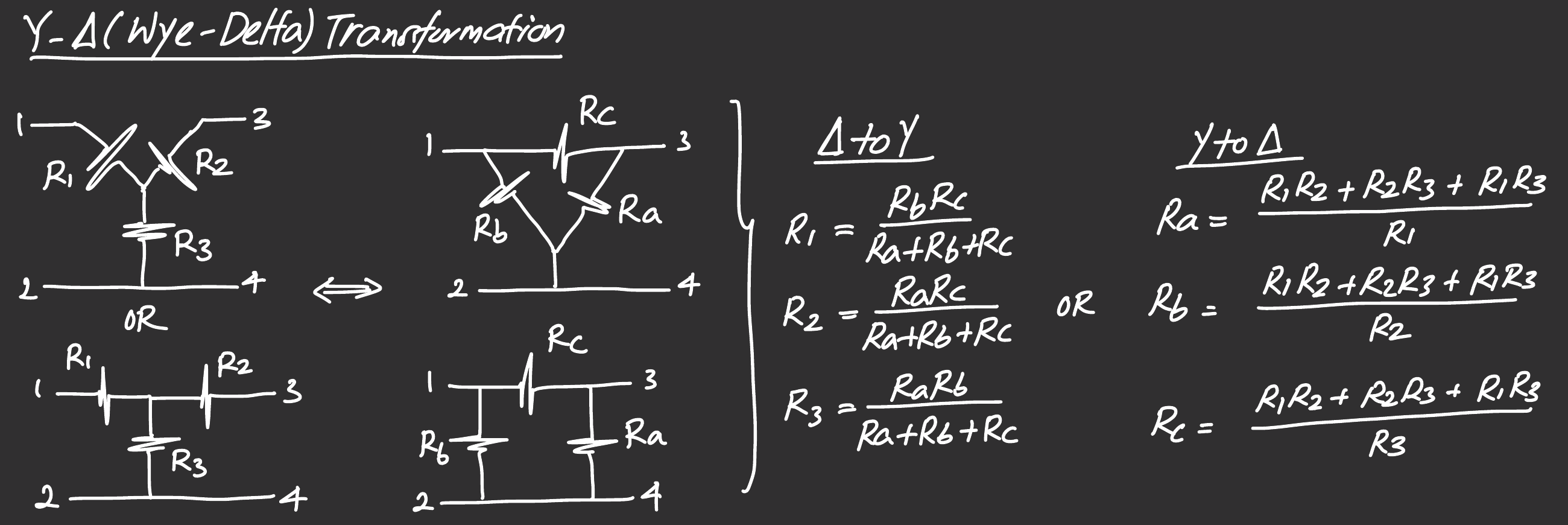
In this layout, form the Y and form the , where is the delta branch opposite the Y branch , and so on.
Delta to Wye
Each Y resistor equals the product of the two adjacent resistors divided by the sum of all three:
Wye to Delta
Each resistor equals the sum of all pairwise products of the Y resistors divided by the opposite Y resistor:
Balanced Case
When all three resistors are equal:
The same formulas work with impedances in AC circuits, and the balanced form is used a lot in three-phase loads.
Worked Example
A with , , has sum :